Put ramekins on a baking sheet. Bake for 25-35 minutes, until puffed and golden. Remove from oven, and let stand for 5 minutes. With a flexible spatula, remove strata to
School Days: The bell is ringing. Take your seat to learn about the folks who’ve shaped — and been shaped by — a North Carolina education. See related articles here.
School Days: The bell is ringing. Take your seat to learn about the folks who’ve shaped — and been shaped by — a North Carolina education. See related articles here.
School Days: The bell is ringing. Take your seat to learn about the folks who’ve shaped — and been shaped by — a North Carolina education. See related articles here.
Even half a century later, Mitch Miller can still picture the bus he rode to school as a young boy growing up in Randolph County.
He remembers that long, imposing frame that seemed bigger than a semi and stood out, even in the predawn darkness, with its bright golden-yellow paint job, accentuated with crisp black lettering.
He remembers waiting at the end of his driveway every morning until he heard the faint engine growl as the bus rumbled toward his house.
Then he remembers the scramble up the steps, past the bus driver and into the aisle to find a seat. Some kids liked sitting up front, hoping to be one of the first ones off the bus. Others preferred the back, out of earshot and eyesight of the driver, where they enjoyed a tad more freedom. Sitting with friends, of course, was also an important consideration.
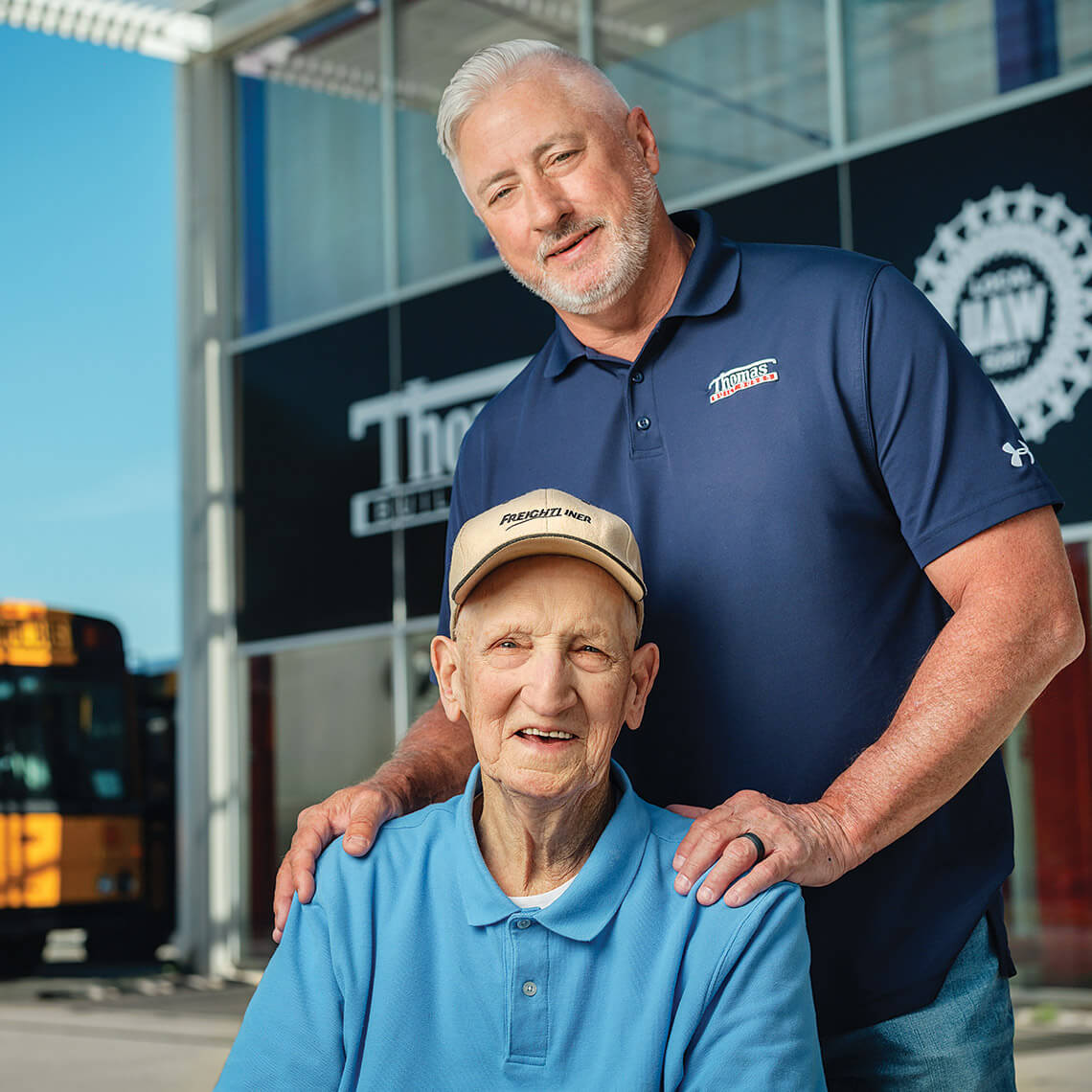
Automation has changed much of the manufacturing process since Bernie Miller worked for Thomas Built Buses, but the pride he and his son, Mitch Miller, feel for their work remains. photograph by Jerry Wolford & Scott Muthersbaugh
And Mitch remembers another seat with a perk: “Back in my day,” the 61-year-old Trinity man says, “you wanted to get in a seat where the window would go down in the summertime. Then in the wintertime, you’d want to sit in a seat where the under-seat heater was close by so you could stay warm. Thankfully, you don’t have to do that anymore.”
In fact, there’s a lot about today’s school buses — including climate-control technology — that would baffle adults of a certain age. A digital instrument panel. Cruise control. Sound systems with sharp speakers. Remote-control mirrors — heated, if you wish. Bluetooth capability with speed-sensing volume controls. Even Wi-Fi.
Clearly, this isn’t your grandfather’s school bus.
“The way buses have advanced is mind-boggling to me,” Mitch says. “It’s still a means of transportation to and from school, but now with all the advancements, it’s a much more comfortable ride.”
• • •
Mitch has a unique perspective on the evolution of the bus. Decades ago, Bernie Miller, his father, spent long, hard days working in the plant at Thomas Built Buses, the High Point company that has become practically synonymous with school buses, especially in North Carolina.
“He started out as a framer,” Mitch recalls. “I remember him coming home dressed in that blue work uniform — dark blue pants and a light blue shirt with his name on it. It was long-sleeved, and it had holes burned in it from the welding. Sometimes even the T-shirt under his work shirt had holes in it.”
The assembly line has come a long way since those days. When Bernie started with Thomas Built in 1960, employees teamed up to push the bus frames from one station to the next, like neighbors moving a car stuck in the snow.
“It was hard work,” recalls Bernie, now 85. “When I first went there, they had a horn that would go off about every 15 minutes, and you had to move the buses [to the next station]. If you weren’t done, you had to go with it and try to catch up.”
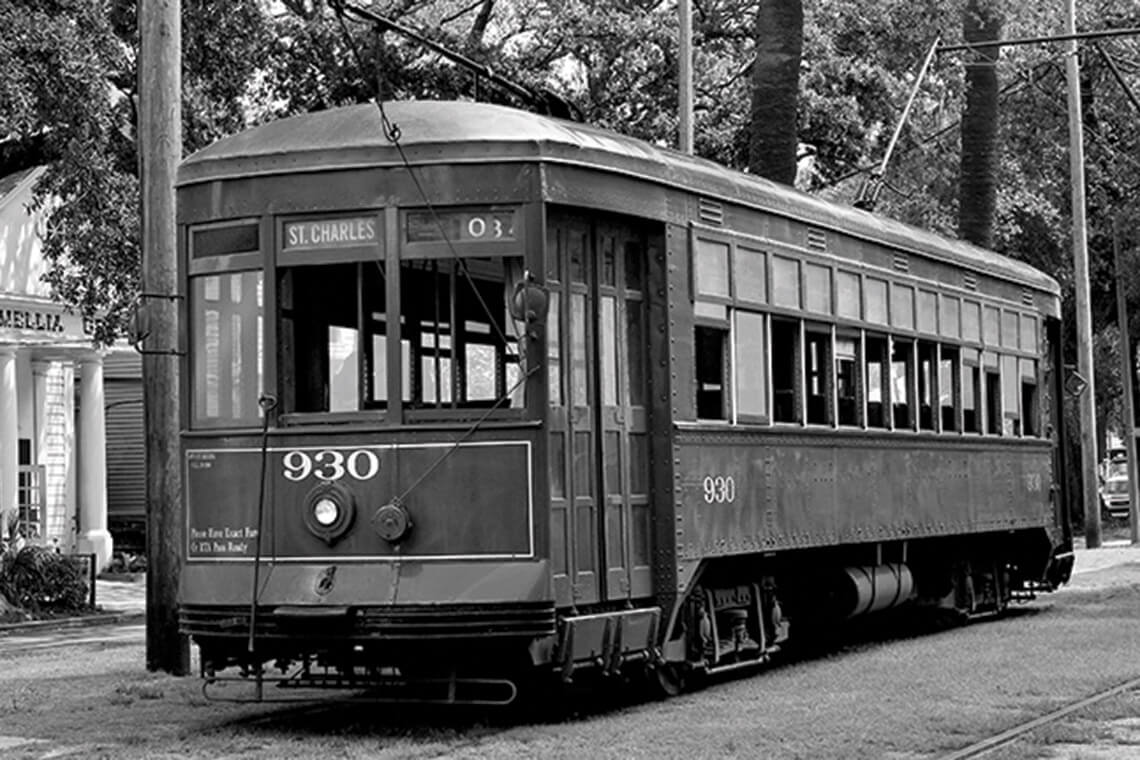
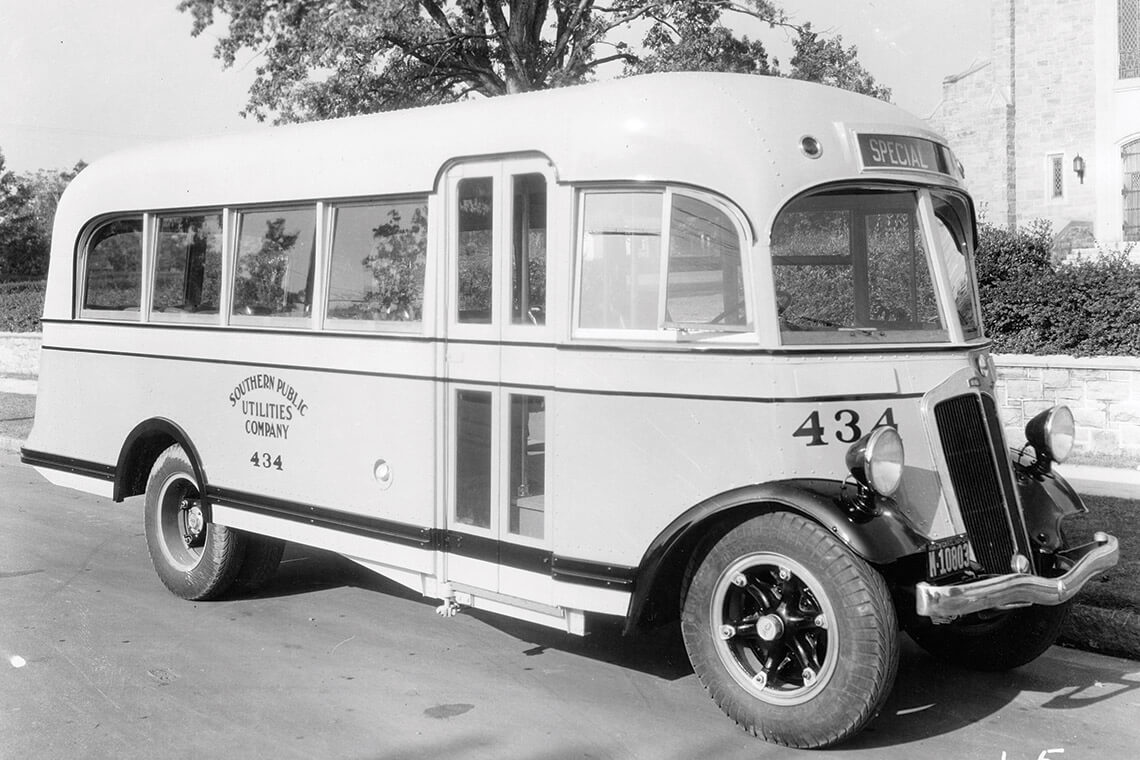
The Perley A. Thomas Car Works legacy has included streetcars, …<br><span class="photographer">Photography courtesy of Thomas Built Buses</span>
… transit buses, …<br><span class="photographer">Photography courtesy of Thomas Built Buses</span>
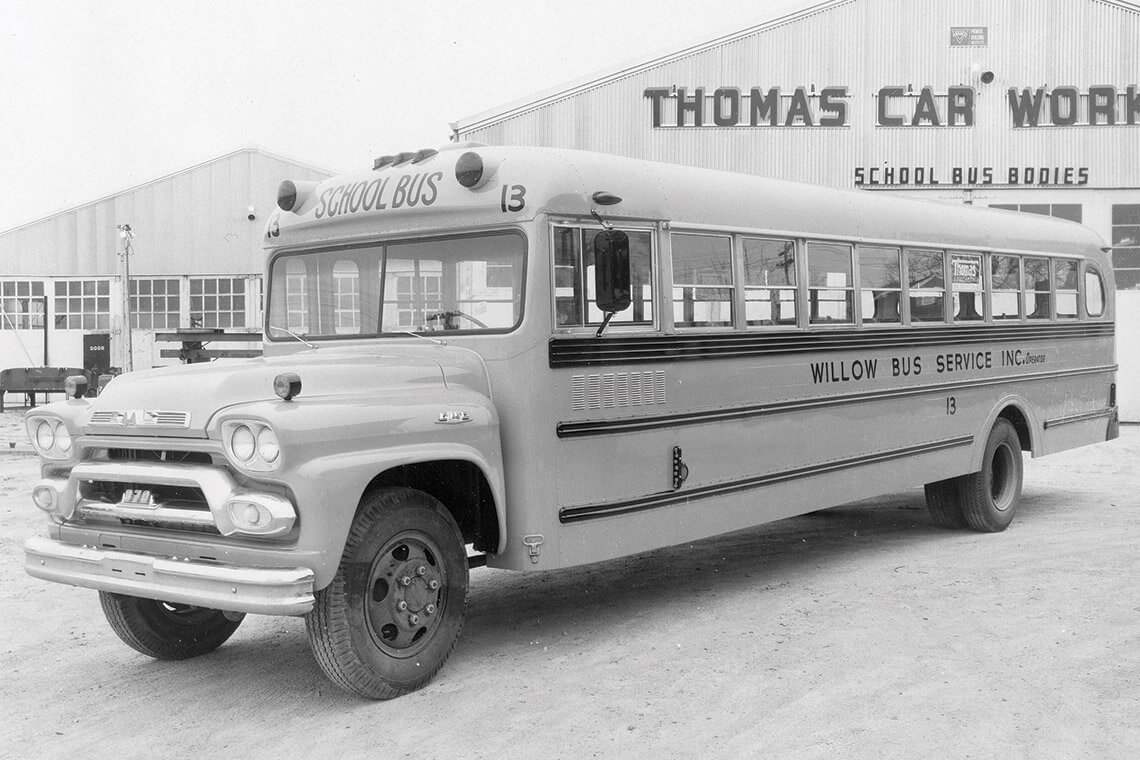
… and bus bodies designed to fit the chassis of major automakers. <br><span class="photographer">Photography courtesy of Thomas Built Buses</span>
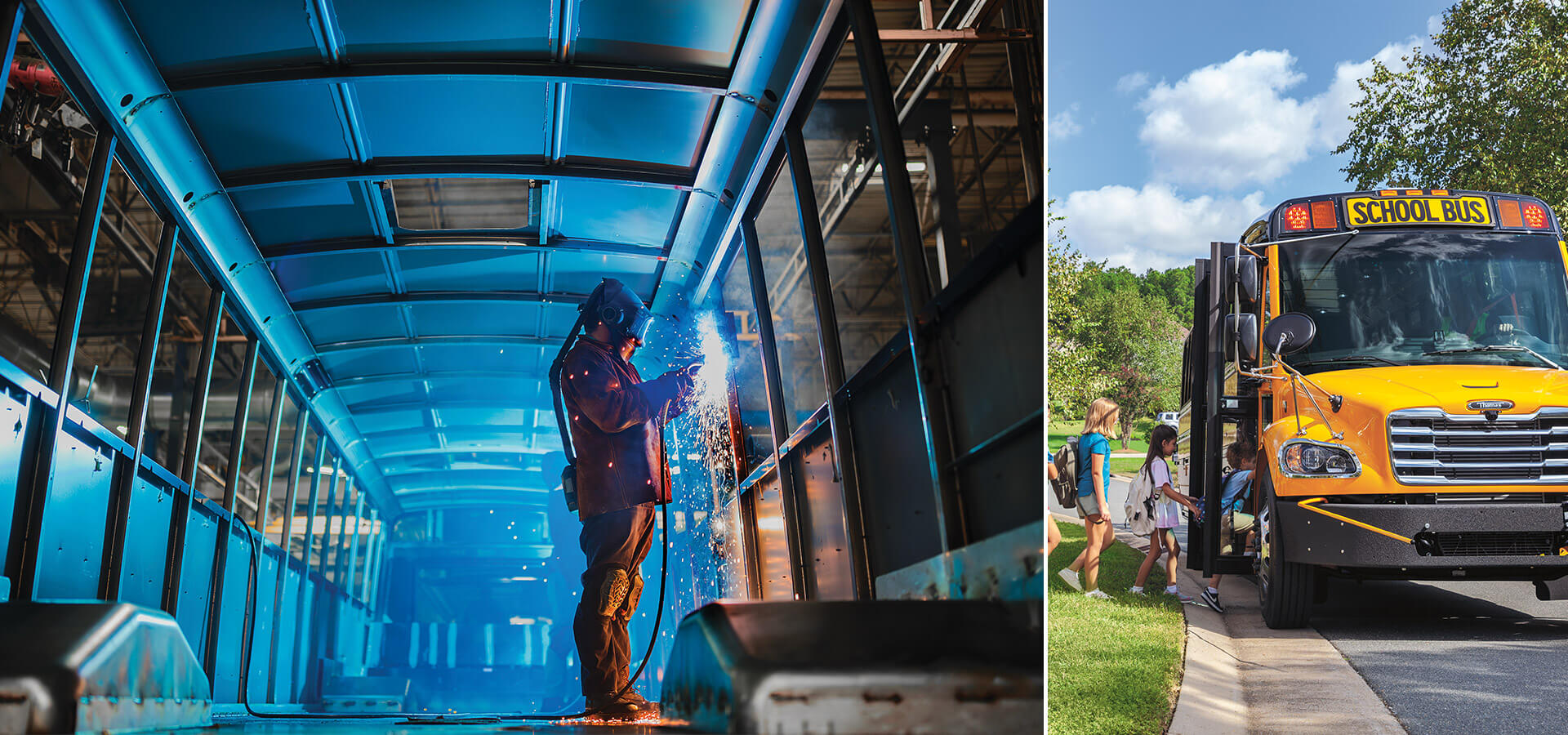
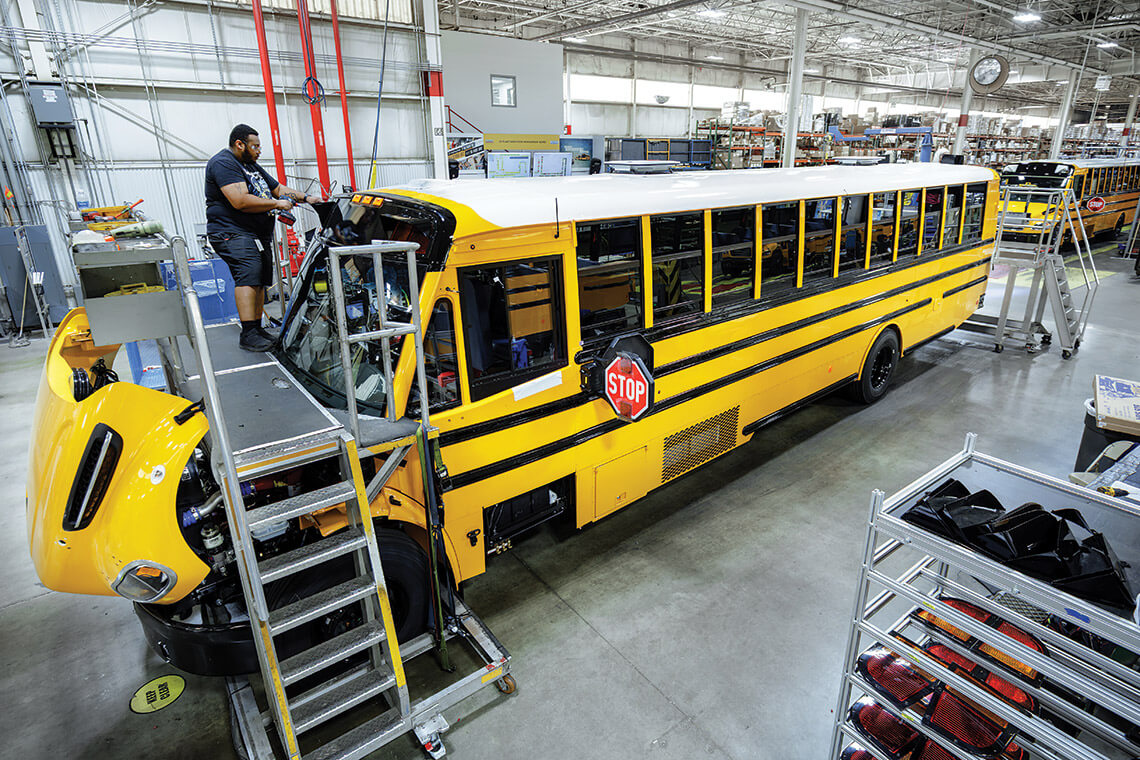
Today, the factory operates like the smooth inner workings of a clock, with a far more efficient use of space than in the old days. The work is still physical, but certain tasks are now automated.
Robots, for example, weld large, metal sheets that quickly begin to form the bus floor. Robotic paint arms coat the buses with the highly visible yellow paint that they’re known for — officially called “National School Bus Glossy Yellow.”
And employees no longer have to push the bus frames from station to station.
It’s been more than 65 years since Bernie first picked up a welding torch on that school bus assembly line. He has long since retired, with 46 years of service under his belt. That sort of longevity is noteworthy, but there’s even more to Bernie’s legacy at Thomas Built — Mitch now works there, too. He started right out of high school and has worked his way up to Southeast regional sales manager.
“Someone in my family has been here for 66 years — over half of the company’s existence.”
“Someone in my family has been here for 66 years,” Mitch says. “Thomas has been in business for 110 years, so that’s over half of the company’s existence that my family has been here.”
At one point, the father and son worked side by side in customer support, traveling together to dealers’ locations to troubleshoot any issues.
“That was really cool,” Mitch says. “He was closing in on the end of his career, and I was just starting out as district service manager, so he was like a mentor to me.”
• • •
The Millers’ story echoes a recurring theme in the rich history of Thomas Built Buses: family. It goes back to 1916, when Perley A. Thomas opened his streetcar manufacturing facility, Perley A. Thomas Car Works, in High Point. By 1936, when the company landed a contract to build 200 wooden school bus bodies for the state of North Carolina — the company’s first foray into manufacturing school buses — Thomas had incorporated his kinfolk into the family business. When he died in 1958, his children and grandchildren led the company forward, building it into one of the nation’s leading school bus manufacturers.
Today, Thomas Built — a subsidiary of Daimler Truck North America — has about 2,000 employees and produces more than 10,000 buses a year, including electric models. Thomas Built vehicles can be found in the school bus fleets of all 100 North Carolina counties and in all 50 states, as well as in Canada, Guam, and Puerto Rico.
Specialists like D’Angelo Payne ensure each school bus meets the company’s standards. photograph by Jerry Wolford & Scott Muthersbaugh
Like Mitch, a good many of those 2,000 employees working at Thomas Built followed in their parents’ — and sometimes their grandparents’ — footsteps. It’s a legacy that continues to grow, as the men and women who keep the buses rolling stand on the shoulders of their ancestors.
The work — or some of it, at least — may have changed, with select gritty, labor-intensive tasks being absorbed by automated equipment. The mission, however, remains the same.
“Everybody who works here has one thing in mind — building a safe product for kids to ride,” Mitch says. “It doesn’t haul goods. It’s built to carry the most precious gift we have — our kids.”
• • •
Sharing that mission is another legacy family, the Callahans. Jason Callahan; his wife, Cherie; and their two children, Vincent and Victoria, all have careers at Thomas Built.
It began with Jason, who joined the company in 1999, working a second-shift fabrication job; he’s now a representative for the North American auto workers union, which acts on behalf of Thomas Built employees. Cherie and Victoria started in 2014, and Vincent was hired the following year. The women have worked at several different stations — Cherie is now a robotics technician, Victoria an assembly technician — and Vincent has primarily been a welder.
Regardless of their roles with Thomas Built, when the Callahans talk about their work or the products they’re making, you can hear the pride in their voices — and in their words.
Victoria, for example, can’t help but marvel at how far the buses have come, even in the couple of decades since she and Vincent were young bus riders themselves.
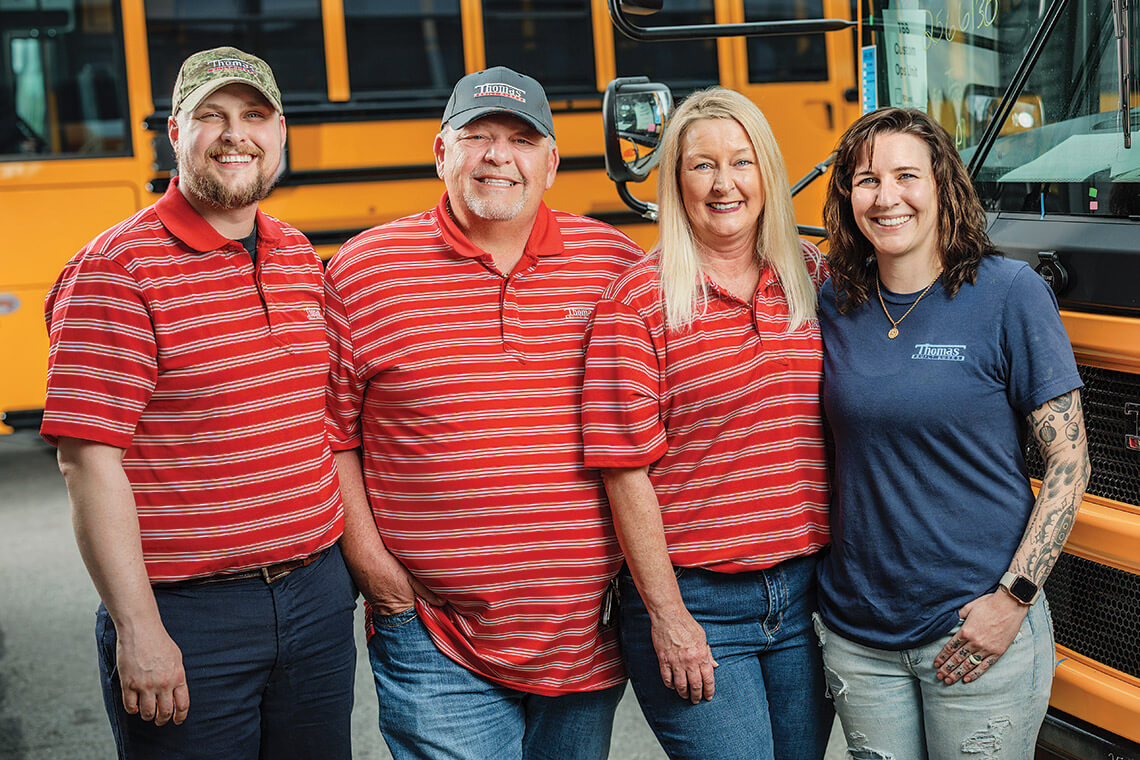
The Callahans (left to right) — Vincent; his parents, Jason and Cherie; and his sister, Victoria — are one of many legacy families whose efforts keep the company going ’round and ’round. photograph by Jerry Wolford & Scott Muthersbaugh
“They’re completely different,” she says. “It’s like riding in a Cadillac now.”
Jason beams at his daughter’s words. He helped build the buses his children rode on, and now they all help build those buses that ride like a Cadillac. It’s a legacy he’s honored to be part of.
“These buses are American-made, built right here in this state,” he says. “And for me personally, I have a sense of pride that … my kids are following in our footsteps — and we’ve got another generation coming through.”
It’s early yet, but Jason’s 11-year-old grandson — Vincent’s son, Valen — has already expressed interest in the family business.
“Papa,” he likes to say, “when I get big, I’m gonna build school buses, too.”
Get our most popular weekly newsletter: This is NC
North Carolina’s story lives in objects made here, used here, treasured here, and sometimes transformed here. They carry the marks of work and worship, progress and protest, music and memory. Some built industries; others built traditions. A few changed the nation. Together, they tell us who we are, who we’ve been, and what we carry forward.
The state’s biggest, highest, oldest, fastest, and farthest places have more than superlatives to their names. They also offer some of our most striking sights.
Possums are not fast or graceful, but they are tough, adaptable, and oddly helpful — eating insects and cleaning up carrion — even as roads remain their biggest threat.
To provide the best experiences, we use technologies like cookies to store and/or access device information. Consenting to these technologies will allow us to process data such as browsing behavior or unique IDs on this site. Not consenting or withdrawing consent, may adversely affect certain features and functions.
Functional
Always active
The technical storage or access is strictly necessary for the legitimate purpose of enabling the use of a specific service explicitly requested by the subscriber or user, or for the sole purpose of carrying out the transmission of a communication over an electronic communications network.
Preferences
The technical storage or access is necessary for the legitimate purpose of storing preferences that are not requested by the subscriber or user.
Statistics
The technical storage or access that is used exclusively for statistical purposes.The technical storage or access that is used exclusively for anonymous statistical purposes. Without a subpoena, voluntary compliance on the part of your Internet Service Provider, or additional records from a third party, information stored or retrieved for this purpose alone cannot usually be used to identify you.
Marketing
The technical storage or access is required to create user profiles to send advertising, or to track the user on a website or across several websites for similar marketing purposes.