School Days: The bell is ringing. Take your seat to learn about the folks who’ve shaped — and been shaped by — a North Carolina education. See related articles here.
The high school is small and old. Its colors are red and black, and where those colors appear — inside and outside the school, on the ball fields — the paint has been carefully maintained. It’s a school where great-grandparents regularly attend performances and graduations held on a stage they themselves once crossed.
I, though, am new here. On my first day, the floors shine in the long hallway that leads, at its very end, to the classroom at the back of the school. My classroom. I’m a career changer, a middle-aged writer trying to find his way. People I care about think I’ll be good at this.
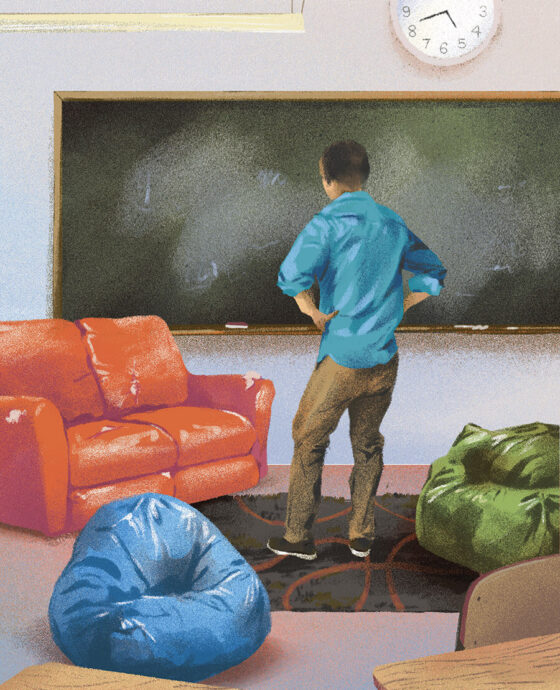
I fill the room with posters of Fyodor Dostoevsky, James Joyce, and Virginia Woolf, none of whom I’ll teach during my first and only year of teaching high school. I have high hopes, though, and believe my students would read more if their classroom was comfortable and, above all, cool. I haul in a couch, a rug, and some beanbag chairs, all of which I will remove before the second semester for a variety of reasons, including the fact that they will become nasty. But in the meantime, I’m idealistic; I romanticize teaching. I’ve watched Dead Poets Society.
I will never forget one of the students and a teacher who sat on that couch.
The Student is a boy who is irrationally enthusiastic about a rumored nude scene in a film version of Romeo and Juliet, and curses me when I stride over to the computer and skip past that scene. His eyes go wide when he looks at me, his mouth clamped shut. I tell him to see me after school.
It’s important to note that I teach in a rural high school. Chances are pretty good that parents of our students also went to school here and were classmates of many of our teachers, whom they also know from church. This is to say, as my principal explained with near glee, it’s customary in our community for parents to believe teachers when they hear their child hasn’t been an absolute, blameless angel. They may even choose to add their own punishments on top of whatever discipline the school sees fit to mete out.
So when the boy slouches into my classroom at the end of the day, eyes down, I say to him: “I can call your parents, or you can clean my room after school.” I know what his answer will be before I ask. And with that we begin a daily ritual: him sweeping my classroom corner to corner.
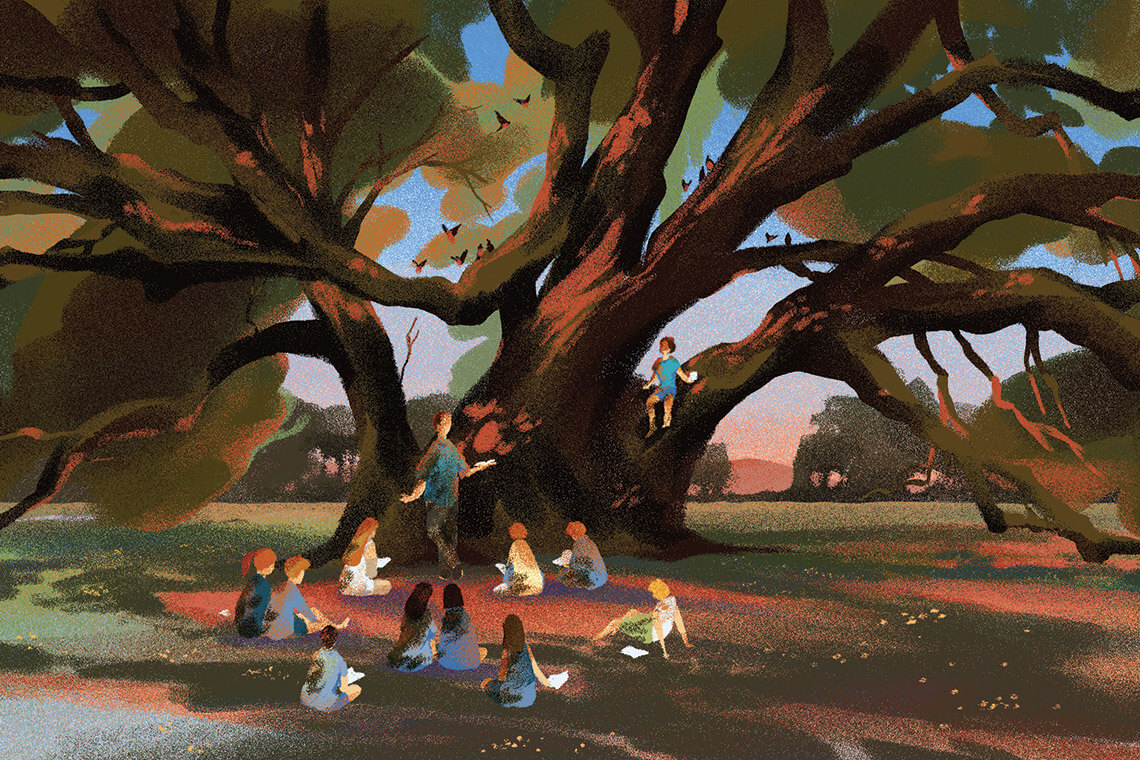
illustration by Andrea Cheung
He complains about all the mud, and I point at his boots, which are identical to the boots of most of the boys who do chores or hunt before school. He sighs.
Over time, I get to know him. He wants to be a lineman someday. I’m sure he’ll work harder at that than he does at The House on Mango Street.
There’s a large oak tree behind the building, by a creek, and he loves when we go out there to read poetry. He doesn’t ever seem to be listening, but then … he pays more attention than anyone to all the life going on around him — in the skies, in the great branches of the tree, in the ag department’s greenhouses — and eventually, I come to believe that is poetry enough.
I like him, and I’m sorry to say that I will lose track of him. He’d be around 24 now, and I choose to picture him up in the mountains getting electricity to people after Hurricane Helene and maybe recognizing that kindness and courage from the books he once read.
My mentor, the department chair, also sits on that couch. She knows better than to put one in her classroom so students have something to fight over, clown around on, and use to act out their teenage hierarchies.
I give up trying to get them to take turns, as my mentor suspected I would. She knows that a new teacher needs to figure out some things for himself. It’s through her that I learn the byzantine system of standards, evaluations, and observations that govern my work in the classroom.
It overwhelms me, but somehow her students walk out of her classroom on fire for books, and she never seems fazed by demands of the bureaucracy. I’ve been doing this a long time, she says. The rules come and go, but if your excitement for reading and writing is real, the students will get it.
That’s the gist of what she told me, though she would have said it with humor and self-deprecation, and a couple of references to her beloved Tar Heels. She makes me want to stick it out in the classroom to be like her.
She will pass away too young; there will be a scholarship established in her name. Years later, my daughter will receive one.
One girl never sits on the couch. When she can, she sits by herself. She is so quiet. She is also the best student I have, a truly talented writer and insightful reader.
She doesn’t have much, and the counselor tells me she doesn’t have a good home life. I try to figure out why she’s not in my honors class, and the best answer I can get is that her father is against it. I don’t know why. She doesn’t volunteer answers in class, and I notice that her classmates — who are usually quick to make fun of everybody — respectfully leave her alone.
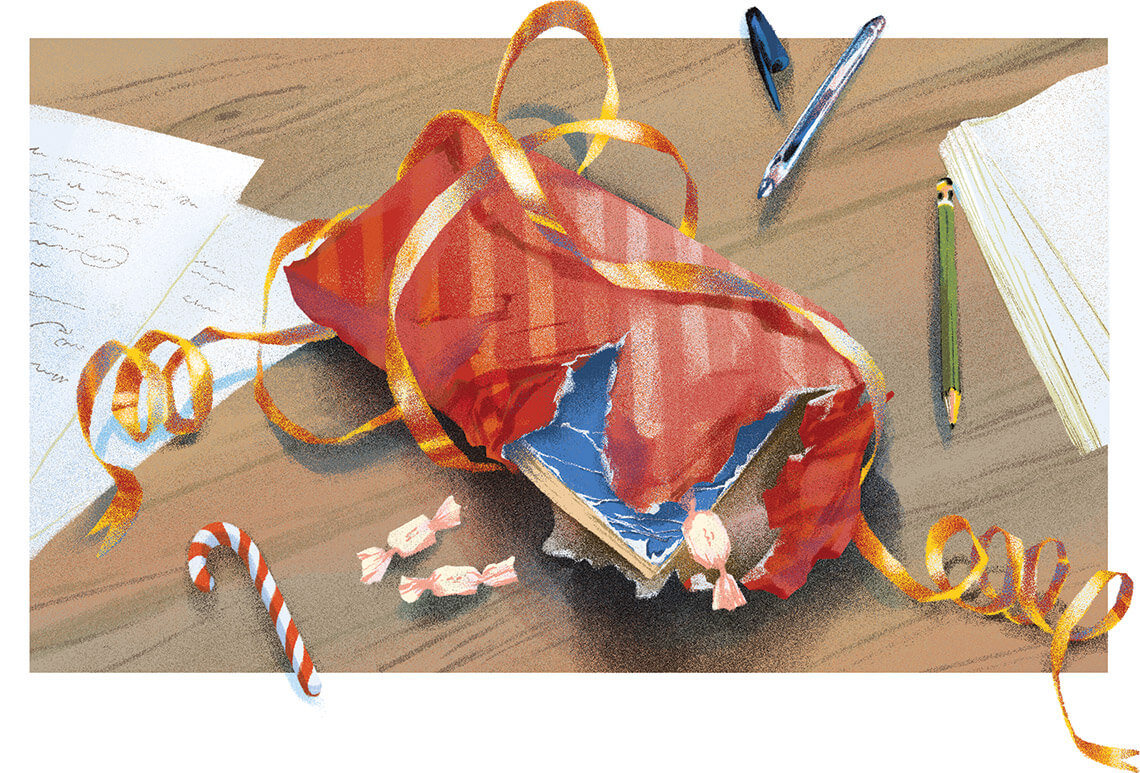
illustration by Andrea Cheung
Around Christmas, I receive a lot of presents from students: gift cards and a bendable flashlight. She brings me a gift wrapped in paper and a bow: a used, well-loved book of hers — a fantasy novel — and a few pieces of candy. She watches me hopefully as I open it, and when I do, I find myself thanking her and not knowing what else to say. She’s happy when she leaves my classroom.
I immediately take a picture of the book and send it to my father. He’d grown up like her, in a very similar school in a very similar place — a smart kid without much, surrounded by an extended family that had even less. I call to tell him about my student and to explain the gift. I tell him that I had a lump in my throat, and I begin to explain why, but I stop. There’s silence on the other end, and then there isn’t. I’ve never heard my father cry before. After a long pause, he says he’s proud.
On that one afternoon, I’m reminded that a school is so much more than school.
print it