School Days: The bell is ringing. Take your seat to learn about the folks who’ve shaped — and been shaped by — a North Carolina education. See related articles here.
Hunched over a table in the back of a classroom, 11th grader John Guillen Mendoza cut foam board into rectangles. Then he glued on hinges and latches, creating panels that could be fitted together or taken apart and carried easily. When he finished, he took home the box — a prototype of a flood barrier — to test it.
In his backyard in Chinquapin, he placed the box on different surfaces, one by one — sand, dirt, gravel, rocks. He set up a fan to simulate whipping hurricane winds before throwing buckets of water onto it to create waves and flood conditions. Each time, the box partially filled with water, the weight of which made his prototype more stable. And each time, it stayed upright. John smiled. It works!
The box is John’s own design. He believes that if manufactured at full scale, it would be a cheaper and more effective flood-control solution than any currently on the market. But that’s a concern for a later date. First, he needed to present his findings at the Duplin County science fair, the regional competition, and ultimately the North Carolina Science and Engineering Fair at NC State.
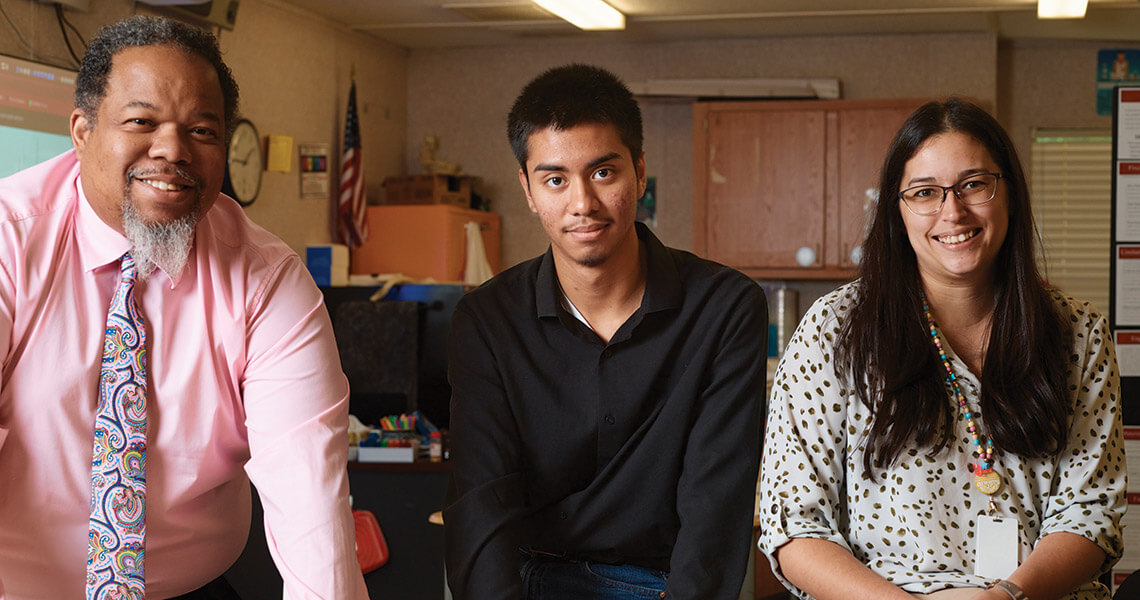
John has an engineer’s mind: curious, practical, and drawn to problem-solving. But his interest in science and engineering has been nurtured by teachers like Garrick Purdie, who help students from all backgrounds see science as something that belongs to them.
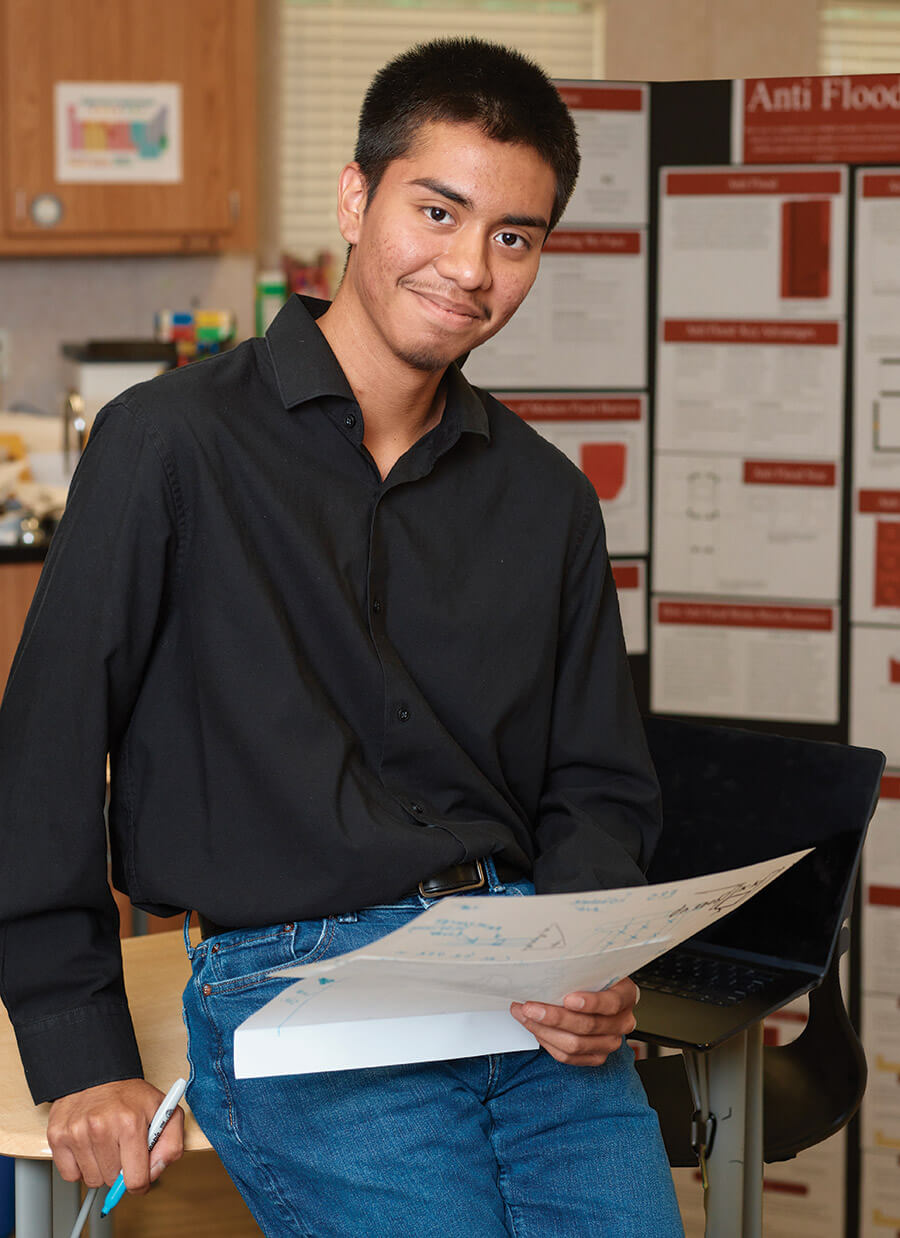
After seeing floods and hurricanes repeatedly affect his Duplin County community, John engineered a prototype flood barrier for the science fair. photograph by Joshua Steadman
John decided not to enter his school’s science fair last year. The year before, his project — an innovative wall design that used triangular supports instead of right angles to better withstand hurricanes and earthquakes — won third place at the regional competition and went on to the state level. After that success, he figured he’d stay behind the scenes and help organize the fair at his school, Duplin Early College High School in Kenansville.
But after last year’s school fair, John paid a visit to Purdie, his science teacher, who keeps his door open, inviting students to stop by and talk about their ideas. As the two chatted, the conversation turned to the upcoming county fair. John had already shown what he was capable of. Purdie knew he could do more. He urged John to enter a project.
“You’re such a brilliant engineering mind,” Purdie told him. “I don’t want you to miss out this year.”
A couple days after their conversation, John sat at the dinner table in his family’s Duplin County home, wrapping up Thanksgiving dinner with a serving of caramel-custard flan.
As he finished off the last bites, his family conversing around him, he thought about the floods and hurricanes that affect his rural community situated between the Northeast Cape Fear River and Muddy Creek. What if a barrier could use floodwater itself to become stronger?
He went back to Purdie and said, “I have something.”
• • •
John completed his first engineering project as a sophomore, but his fascination with how things work began much earlier. As a child, he spent hours building models and watching How It’s Made, a television program that explores how products of all kinds are manufactured.
Eventually, he realized he had a knack for devising creative solutions to everyday problems — like the tool he designed to speed up measurements on the construction jobs he works with his father. And when he saw frequent floods and hurricanes affecting his community, he began imagining ways to lessen their impact.
His science classes gave that curiosity room to grow. Right away, he took to Purdie, who, in just four years at the school, has taught chemistry, environmental science, and biology — all with a very hands-on approach.
On the first day of his chemistry class, Purdie had his students set steel wool on fire with batteries on top of a scale to learn about conservation of mass. School administrator Tanya Smith smelled smoke and ran down the hallway, looking for the fire. But once she understood what he was doing, she gave him free rein.
“It doesn’t matter what your color is, it doesn’t matter how much money you have, it doesn’t matter that you come from little Duplin County,” Purdie reminds the kids who walk the halls. “We’re going to do science.” photograph by Joshua Steadman
“I like to teach through phenomena,” Purdie says. “Ask a question, and let’s do something. Let’s let you see something. Let’s let you experience something, then talk about what we learn, what we observe, how it matters, and how it relates to whatever we’re doing.”
Before an experiment, Purdie asks students to imagine what might happen and make predictions on their whiteboards. Once the lab is underway, he moves from group to group, asking questions that push students to think more critically: What do you notice? Why do you think that happened? What would you expect to happen next? He makes sure every student’s voice is heard, coaxing the quieter ones to participate. When the smoke has cleared — sometimes literally — Purdie has them talk through their predictions and the results.
Last year, he shared his approach with Katherine Johnson, a student teacher who earned her biology degree at UNC Wilmington before completing a master’s in education there in the spring. Her plan is to teach high school science in the area. “Teaching wasn’t something I settled on,” she says. “It’s something that I realized over time I was always called to do.”
Johnson sees that calling most clearly in a school like Duplin Early College High School, where many of the roughly 200 students are young women or people of color. Both groups have long been underrepresented in STEM — science, technology, engineering, and mathematics. As a woman in science, Johnson says she feels a responsibility to help students like John imagine themselves there, too. Purdie feels that responsibility just as deeply.
“It’s good for underrepresented kids to see an underrepresented scientist,” he says. “For a lot of these kids, society tells them that maybe science and math aren’t for them. What’s important is that you want to do science. We’re going to do science. You want to research something? By God, if I can figure out a way for us to do it, I will.”
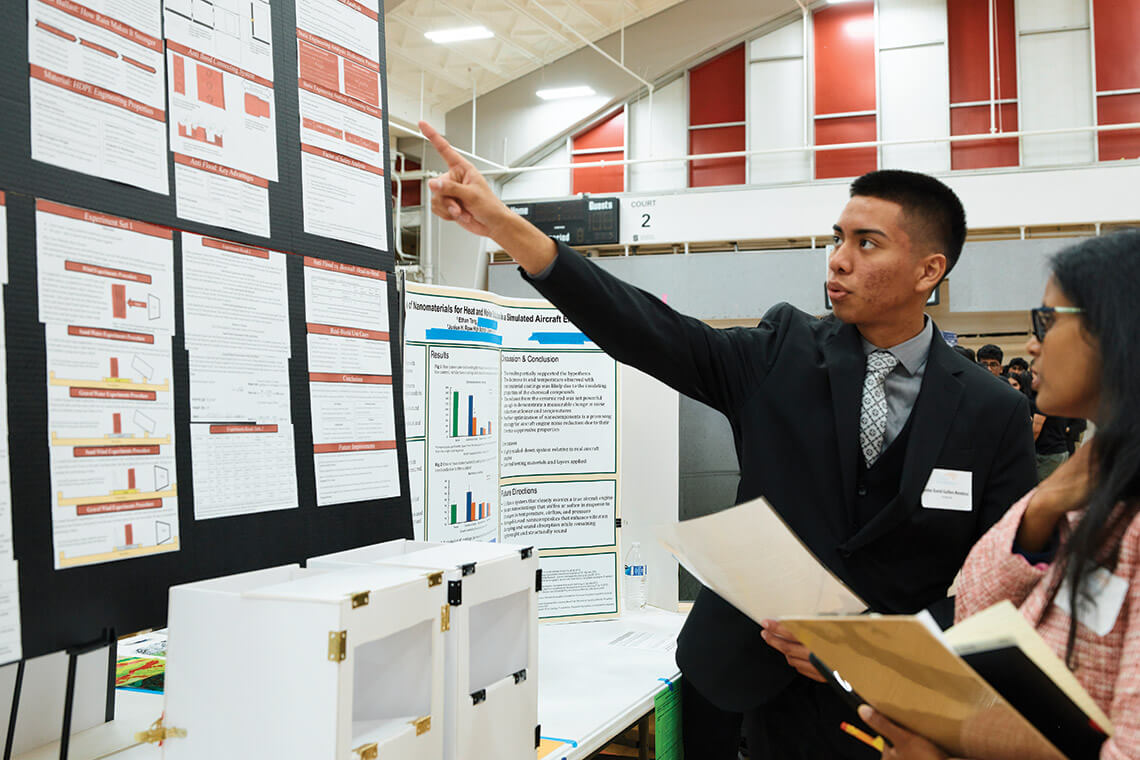
John presented his findings to judge Shilpa Botu at the North Carolina Science and Engineering Fair at NC State. His project didn’t place, but his teachers have taught him to keep experimenting. photograph by Joshua Steadman
That sense of belonging begins with representation, but it grows through everyday moments: a teacher’s open door, a hands-on lesson, a thoughtful question, a willingness to show students that science is not only rigorous but also joyful.
“I think it’s so important to let your students see you be a nerd,” Johnson says, “because you don’t dedicate your studies and your professional life to teaching this subject without just loving it.”
Johnson’s undergraduate research experience came in handy as she helped John shape his project for the fair. She provided guidance on methodology, reminding him that results need to be repeatable, and helped him sharpen the language and flow of his presentation. And as he built his prototype in the back of the classroom, she would stop by to check on his progress and offer encouragement — and a gentle reminder to clean up when he was done for the day.
John didn’t need help coming up with his design. The idea was his. But Purdie gave him the encouragement he needed, Johnson guided him on the scientific process, and the school helped with materials and contest paperwork. The project was his own, but he couldn’t have completed it without all of them.
• • •
On the day of the competition, the rising senior stood in front of his poster board, fidgeting with the box in his hands. His palms were sweaty, his heart racing. When the judges stopped by to talk to him, he explained how his design works and the testing that went into it.
During the awards ceremony later that afternoon, John sat in the back of the audience, his fingers tapping anxiously on his chair. Like the other students around him, his eyes remained glued to the stage. Beside him sat Purdie, supporting his student as always.
Organizers called each category one by one. When they finally got to the engineering awards, John’s project didn’t place. He was disappointed. But Purdie calmly turned to him and told him encouragingly: It’s the journey that’s the win. There’s always next year and the next project, and that one’s bound to blow the competition out of the water.