Put ramekins on a baking sheet. Bake for 25-35 minutes, until puffed and golden. Remove from oven, and let stand for 5 minutes. With a flexible spatula, remove strata to
Listen as the pages of the magazine come to life in the Storytellers podcast showcasing the voices of Our State writers. Each podcast episode features a writer reading their column
Listen as the pages of the magazine come to life in the Storytellers podcast showcasing the voices of Our State writers. Each podcast episode features a writer reading their column
Listen as the pages of the magazine come to life in the Storytellers podcast showcasing the voices of Our State writers. Each podcast episode features a writer reading their column aloud, allowing each distinct voice to shine. Click below to listen to Eleanor read her column aloud.
Most of us can hear the hush of snow, at least every once in a while, or the creaking of leafless branches moving against each other in the winter wind. If we listen, we hear the patter of animal feet on dry ground at night, the air cleared of katydids and crickets until spring. Only a few of us, however, get to hear the otherworldly sound of wild ice.
Most of North Carolina doesn’t get cold enough to freeze streams and ponds for any significant length of time. When ice and snow do come south and east, it feels like an alien takeover. We cancel school, hunker down, don’t dare drive anyplace. Ice and snow turn us into spindly-legged fawns, scrabbling around for purchase. And like fawns, we hear the world with new ears.
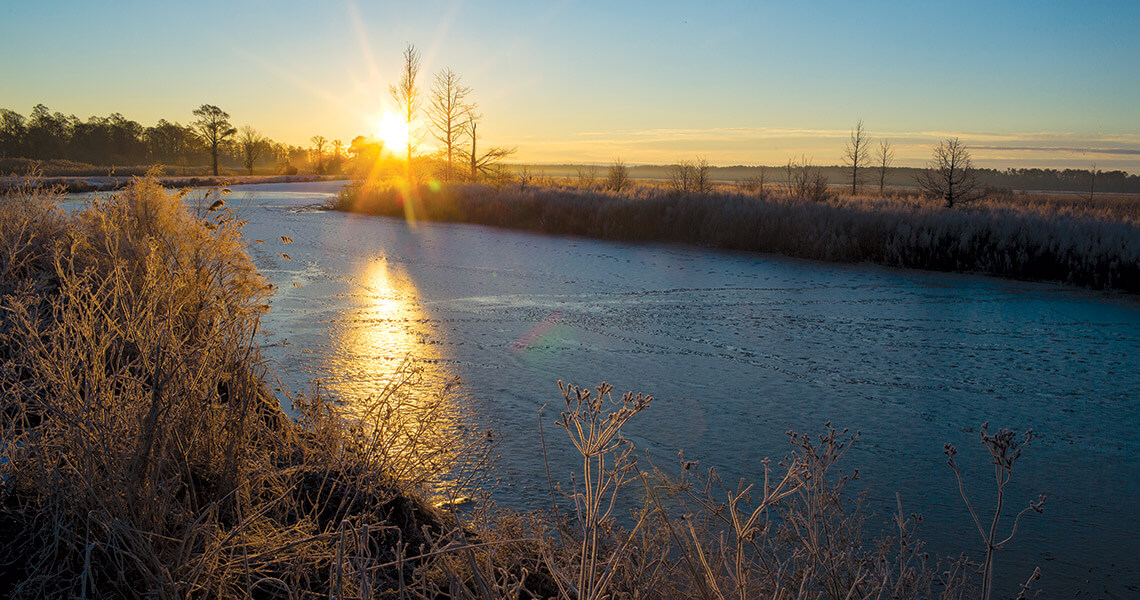
When cold temperatures descend on the swamps and canals of eastern North Carolina, slow-moving water in places like Lake Mattamuskeet can freeze, leaving stretches of ice that creak and moan. photograph by Neil Jernigan
The first time I heard the sound of wild ice, I was a teenager exploring a swamp with my parents on a Sunday afternoon. Most Sunday afternoons were reserved for “going to the woods.” In Wayne County, and throughout North Carolina, hunters were prohibited from killing on the Lord’s Day, so we were free to look and wander, even during deer season.
It had been unusually cold that year. The swamp streams and puddles were covered in a layer of ice, something I’d never seen before and haven’t seen since. When we stepped on them, the ice split, resonated like plucked steel cables. Perrrrnnnnn! Pewww! The cracking layers sounded like laser guns. Like whales singing to each other in the ocean depths.
The second time I heard wild ice, I was 20 years older, throwing rocks and pine cones at a frozen pond in Durham with my two sons. None of us had seen a pond frozen over before. I’d moved far enough away from that swamp in Wayne County that I thought it had all been a dream. But there it was, on that pond, the preternatural chords reverberating in the winter air.
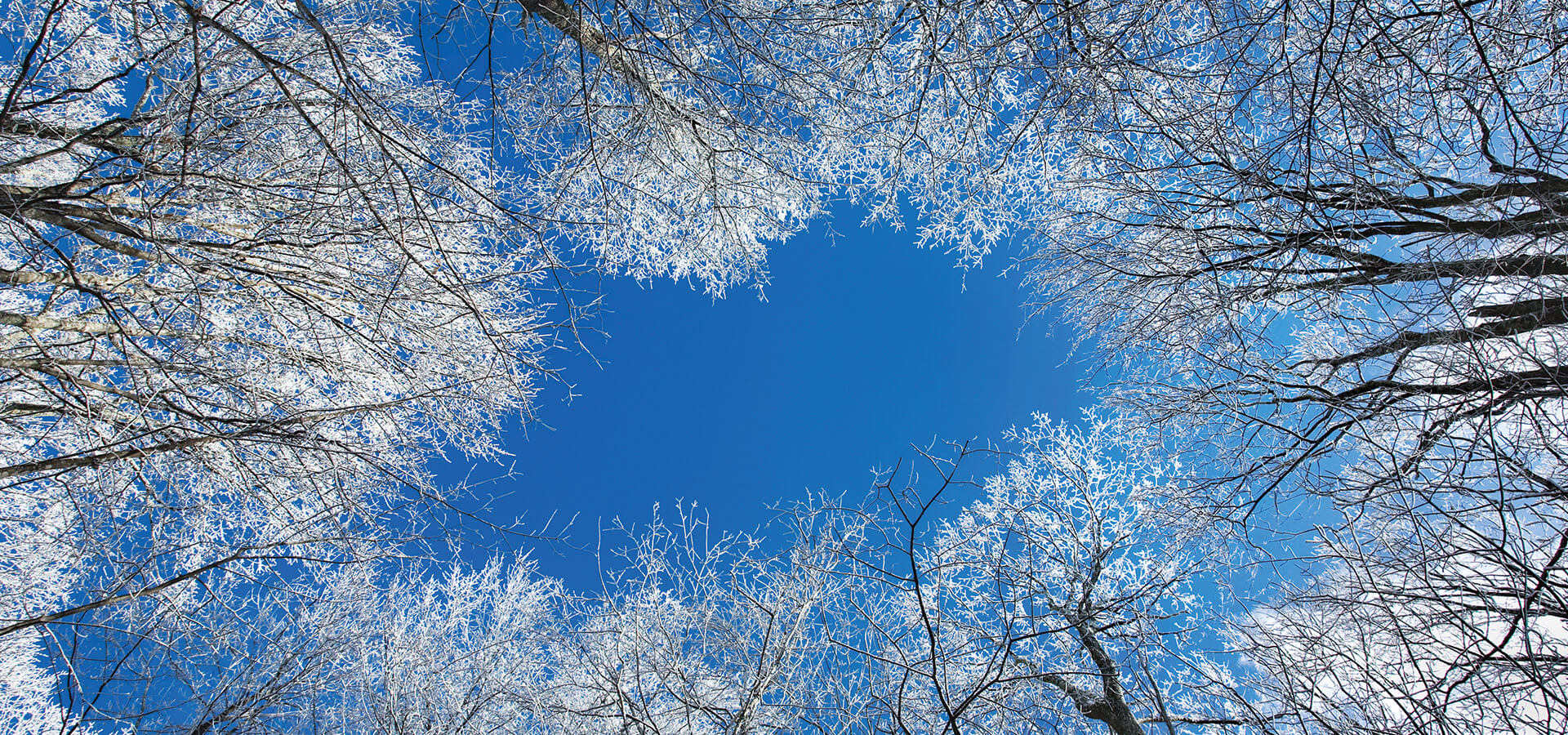
Ice in glasses tinkles and cracks. Crushed ice shushes and grumbles. But wild ice, the ice no human can make, the ice that covers streams and ponds and lakes, has its own language. When bodies of water freeze, especially in warmer places like North Carolina, they don’t usually freeze solid. Instead, they leave the river and pond beneath to slosh. The lid of ice, stretched taut like the head of a drum, rattles the water below. It cracks, sends vibrations deep down and up above. These vibrations make sounds, the twangs and croons of wild ice.
We’re in the perfect place to hear those sounds. In colder climates, when the water gets too frigid, the ice becomes too thick to vibrate, too heavy to move. It silences any water beneath.
We don’t get too cold. Most winters, we get just cold enough for wild ice to sing. It hums and moans, shoots and warbles. It turns the heads of phoebes and squirrels — they, too, wonder over the eerie refrains of water that once splashed and trickled. These animals don’t know whale calls; they’ve never heard a laser gun in the movies. For them, it’s just the music of a frozen day.
Get our most popular weekly newsletter: This is NC
North Carolina’s story lives in objects made here, used here, treasured here, and sometimes transformed here. They carry the marks of work and worship, progress and protest, music and memory. Some built industries; others built traditions. A few changed the nation. Together, they tell us who we are, who we’ve been, and what we carry forward.
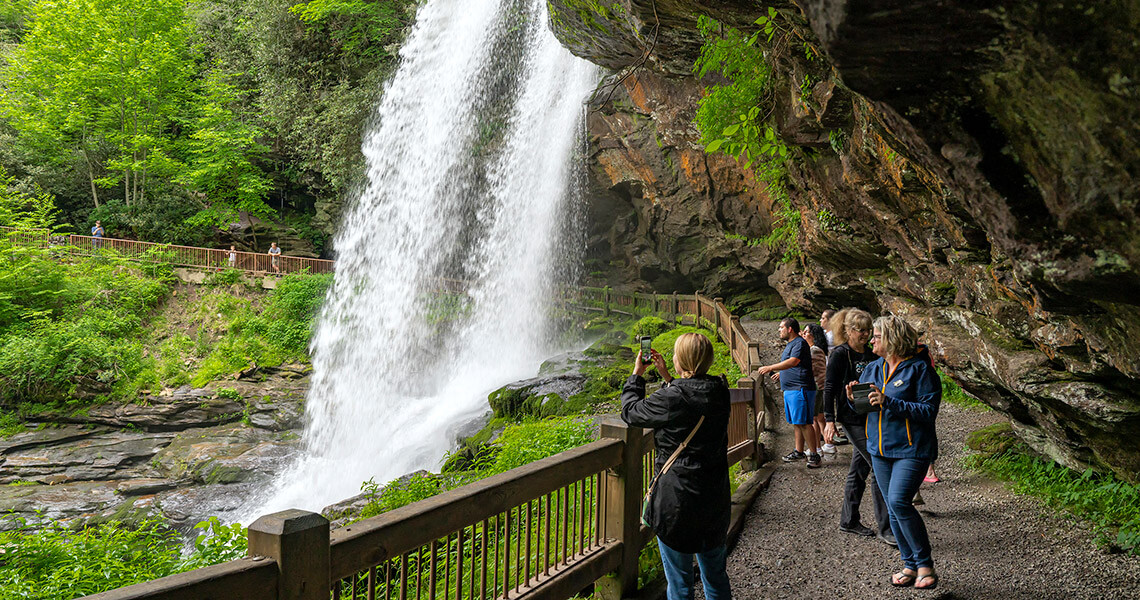
The state’s biggest, highest, oldest, fastest, and farthest places have more than superlatives to their names. They also offer some of our most striking sights.
Possums are not fast or graceful, but they are tough, adaptable, and oddly helpful — eating insects and cleaning up carrion — even as roads remain their biggest threat.
To provide the best experiences, we use technologies like cookies to store and/or access device information. Consenting to these technologies will allow us to process data such as browsing behavior or unique IDs on this site. Not consenting or withdrawing consent, may adversely affect certain features and functions.
Functional
Always active
The technical storage or access is strictly necessary for the legitimate purpose of enabling the use of a specific service explicitly requested by the subscriber or user, or for the sole purpose of carrying out the transmission of a communication over an electronic communications network.
Preferences
The technical storage or access is necessary for the legitimate purpose of storing preferences that are not requested by the subscriber or user.
Statistics
The technical storage or access that is used exclusively for statistical purposes.The technical storage or access that is used exclusively for anonymous statistical purposes. Without a subpoena, voluntary compliance on the part of your Internet Service Provider, or additional records from a third party, information stored or retrieved for this purpose alone cannot usually be used to identify you.
Marketing
The technical storage or access is required to create user profiles to send advertising, or to track the user on a website or across several websites for similar marketing purposes.



 Listen as the pages of the magazine come to life in the