Put ramekins on a baking sheet. Bake for 25-35 minutes, until puffed and golden. Remove from oven, and let stand for 5 minutes. With a flexible spatula, remove strata to
Listen as the pages of the magazine come to life in the Storytellers podcast showcasing the voices of Our State writers. Each podcast episode features a writer reading their column
Listen as the pages of the magazine come to life in the Storytellers podcast showcasing the voices of Our State writers. Each podcast episode features a writer reading their column
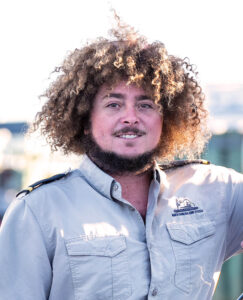
Surfer and waterman Pat O’Neal knows the difference between a good ride and a great one, and why the waves off Hatteras hold their power longer than anywhere else on the East Coast.
Listen as the pages of the magazine come to life in the Storytellers podcast showcasing the voices of Our State writers. Each podcast episode features a writer reading their column aloud, allowing each distinct voice to shine. Click below to listen to Eleanor read her column aloud.
On one amazing day, the swell was perfect, the point break just right, and Hatteras Island surfer Pat O’Neal rode a wave for 80 seconds. That’s roughly 75 seconds longer than most of us spend with any wave. Most of us sit at the shore and wait for it to lift and drop, or to crash at our ankles, racing its foamy fingers across the sand to grab shells and shark teeth and drag them back to the dark water.
Pat O’Neal photograph by Daniel Pullen
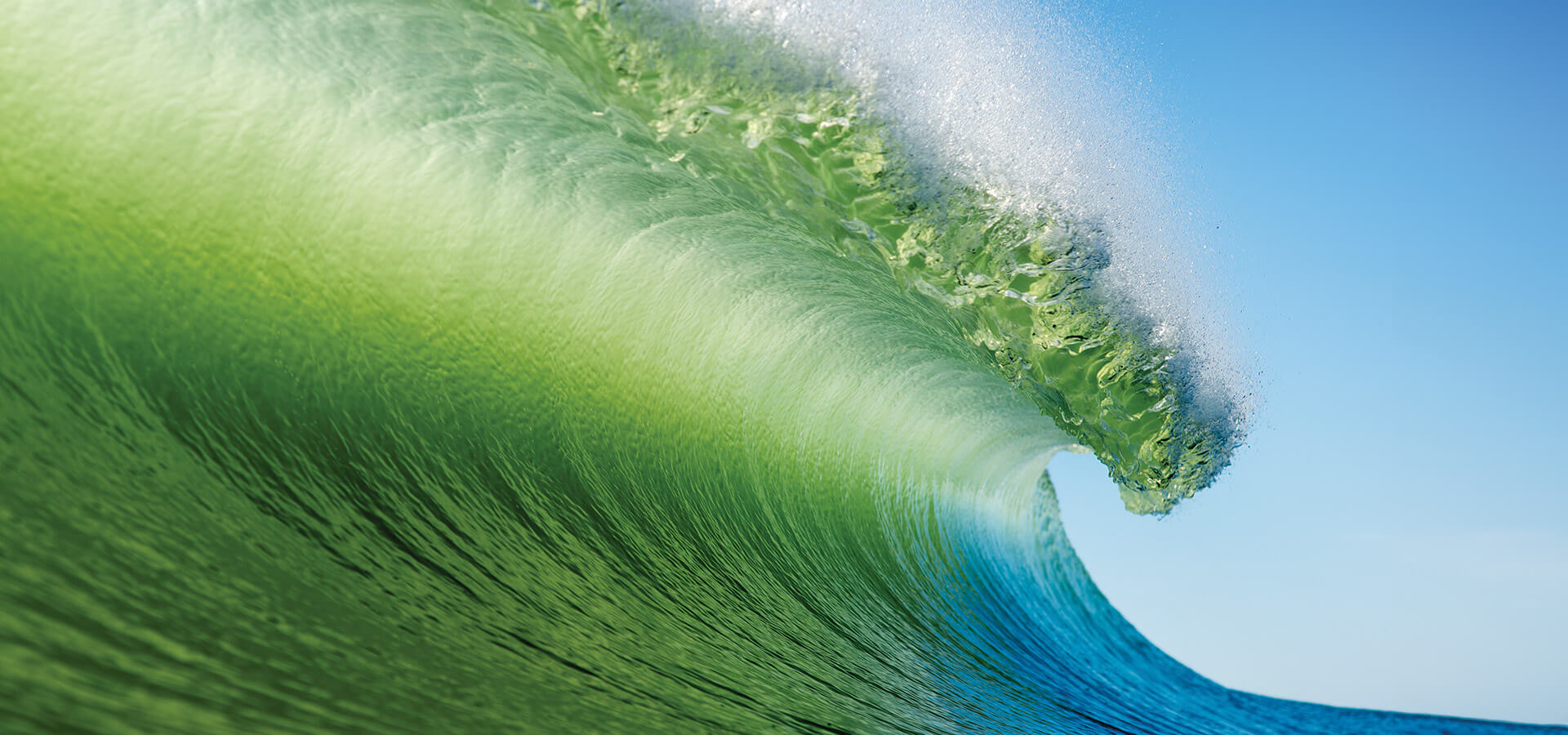
Even O’Neal’s longest, however, pales in comparison to a wave’s lifespan. Before it ever reaches his board, that swell — and the others it has joined — has traveled thousands of miles across open water, born from the conjoining of wind’s pure energy and the malleable ocean surface. It is a union of two of our planet’s most powerful forces: weather and water.
A wave’s motion should not be confused with the motion in a river or stream. If you drop a twig into a river, you may never see it again. It will venture toward bigger rivers, toward the ocean.
Drop a twig — or yourself, for that matter — in the middle of the ocean and a wave will lift and drop you almost where you started, same place, mostly same water.
A wave rolls over whale barnacles and sea turtle tails, around barges and beneath the star-worn night sky until it trips on the shallows near the coast, slows, stumbles, and topples over, crashing onto the shore.
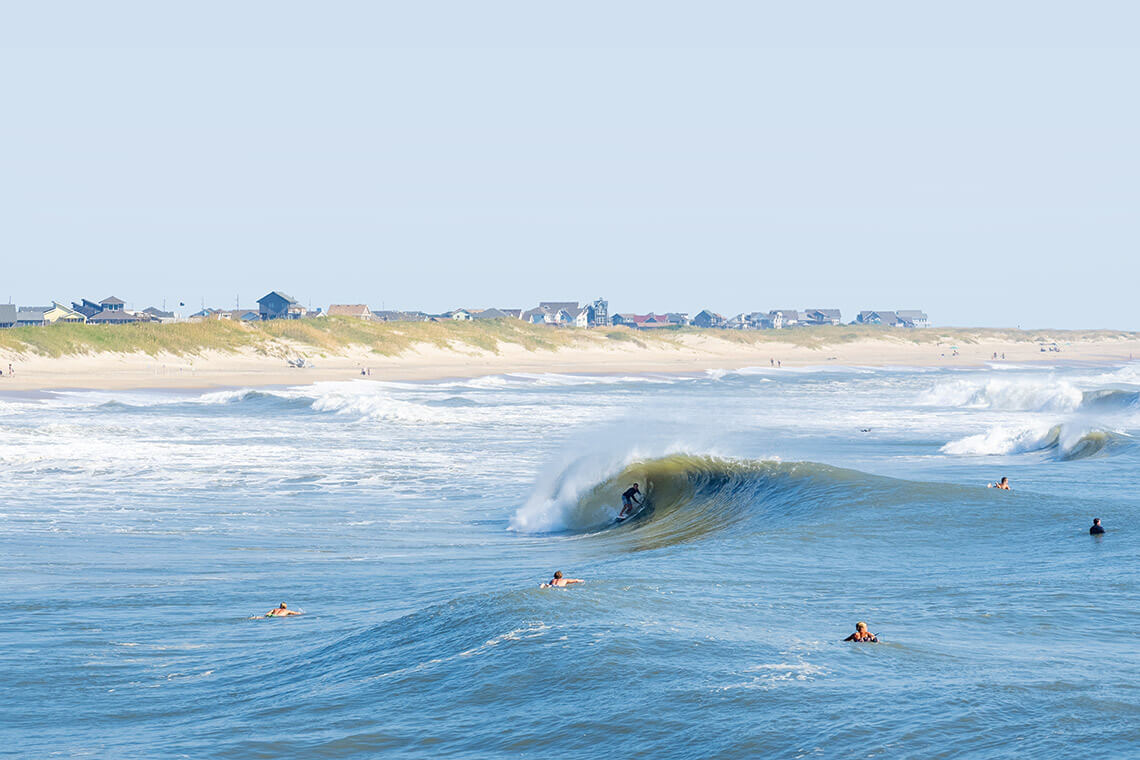
“The reason the waves are so big on Hatteras is that we’re so close to a continental shelf,” O’Neal says. “In other places on the East Coast, the water hits the shelf earlier and slows down, but here it retains its power, hits the sandbar, and curls over itself.”
O’Neal’s family has watched Hatteras’s waves for more than 100 years. Like most longtime Outer Bankers, “my family are all watermen,” he says.
A ride with O’Neal at his job on the Hatteras-Ocracoke passenger ferry connects with odd branches of his family tree: relatives’ names attached to a large sandbar the boat chugs over.
“To be a waterman, you have to know how to read the current, the waves, the tides,” he says. “I figured it out, how to read the water.”
He sees water flowing off the tides, can tell how to ride a wave by which way it stumbles. Like his forefathers, O’Neal works engulfed by the ocean, plays against it, watches it and listens to it as we watch and listen to anyone else we love. In return, the ocean speaks back, tells her secrets.
To read the water is to be able to see through walls. The green and brown depths, inscrutable to most, will reveal her temperament to those who learn to read her, her life writhing within, what she is prepared to give up, what she wants to take.
From the Avon Fishing Pier, a clean swell rises and folds toward shore, the kind of moving water Pat O’Neal has spent a lifetime learning to read. photograph by Daniel Pullen
O’Neal fishes still, as many surfers do, listening to what the waves tell him and understanding that the stumbling sea holds much more than water and light.
“Down here in the ocean, southwest winds can be the best for most fish,” O’Neal says.
Reading the water also depends on the time of year and the tides, he says. “Like, in the spring, the bluefish seem to run on the northeast winds, and in the mid-spring to late fall, the big red drum run off the point in Buxton. The pretty days with no wind are good for pompano.”
A river’s waters are temporary, each place in the water making a brief visit on its way someplace else. Ocean waves seem to come and go, but they’re not going anywhere, not really. They can be caught, but never kept.
Get our most popular weekly newsletter: This is NC
North Carolina’s story lives in objects made here, used here, treasured here, and sometimes transformed here. They carry the marks of work and worship, progress and protest, music and memory. Some built industries; others built traditions. A few changed the nation. Together, they tell us who we are, who we’ve been, and what we carry forward.
The state’s biggest, highest, oldest, fastest, and farthest places have more than superlatives to their names. They also offer some of our most striking sights.
Possums are not fast or graceful, but they are tough, adaptable, and oddly helpful — eating insects and cleaning up carrion — even as roads remain their biggest threat.
To provide the best experiences, we use technologies like cookies to store and/or access device information. Consenting to these technologies will allow us to process data such as browsing behavior or unique IDs on this site. Not consenting or withdrawing consent, may adversely affect certain features and functions.
Functional
Always active
The technical storage or access is strictly necessary for the legitimate purpose of enabling the use of a specific service explicitly requested by the subscriber or user, or for the sole purpose of carrying out the transmission of a communication over an electronic communications network.
Preferences
The technical storage or access is necessary for the legitimate purpose of storing preferences that are not requested by the subscriber or user.
Statistics
The technical storage or access that is used exclusively for statistical purposes.The technical storage or access that is used exclusively for anonymous statistical purposes. Without a subpoena, voluntary compliance on the part of your Internet Service Provider, or additional records from a third party, information stored or retrieved for this purpose alone cannot usually be used to identify you.
Marketing
The technical storage or access is required to create user profiles to send advertising, or to track the user on a website or across several websites for similar marketing purposes.



 Listen as the pages of the magazine come to life in the