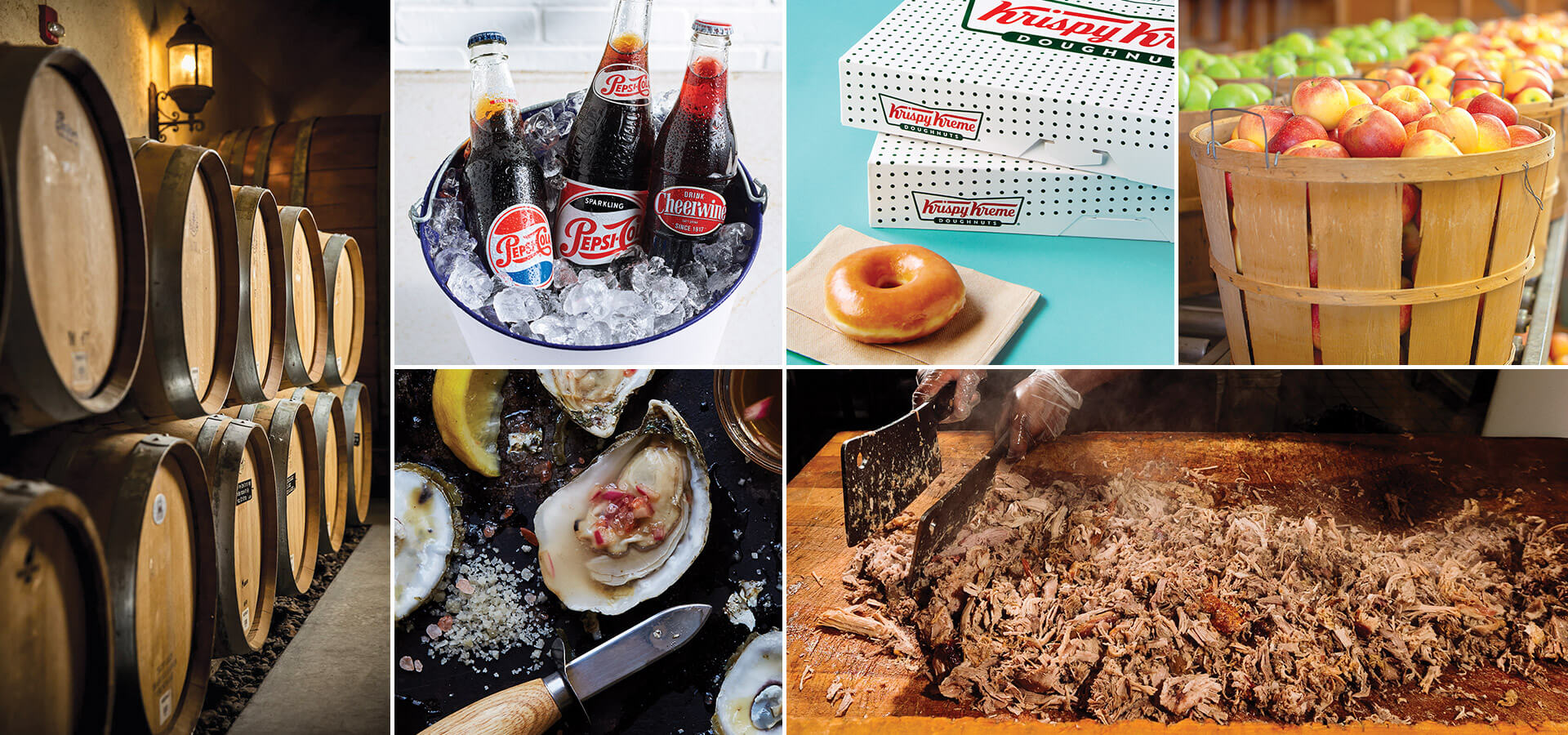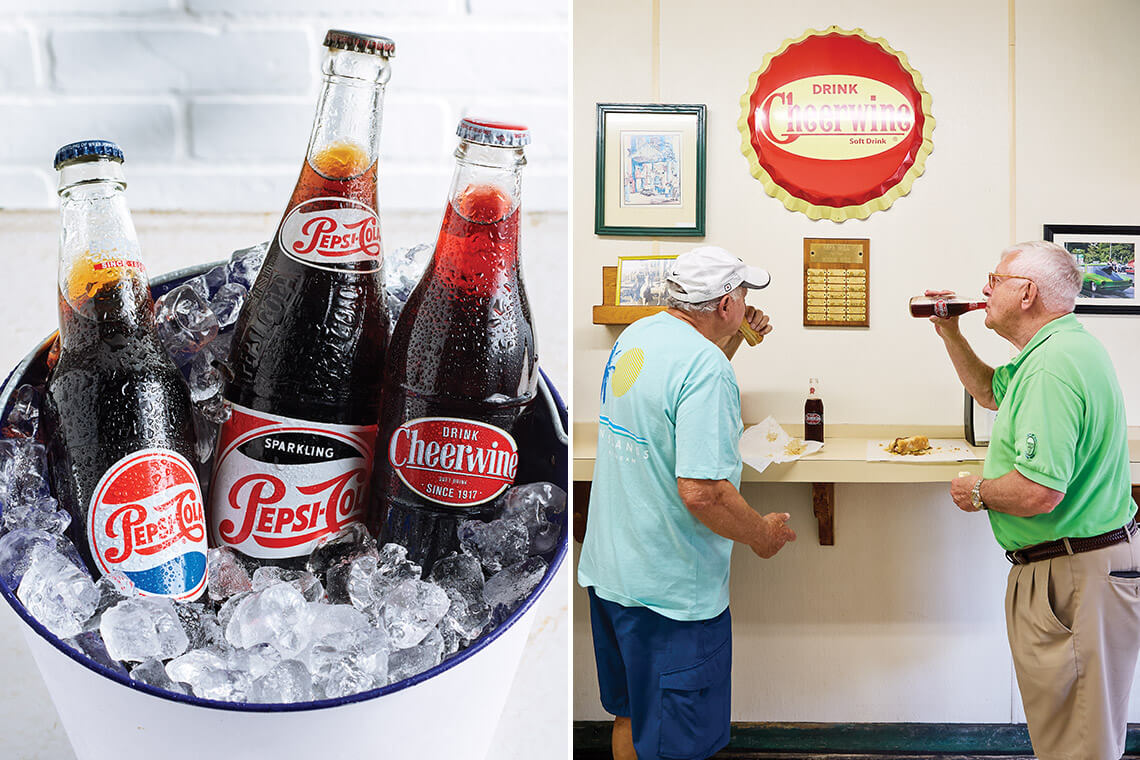
At Hap’s Grill in Salisbury, a hot dog “all the way” pairs perfectly with an ice-cold Cheerwine in a glass bottle. Regulars Don Richardson (left) and Buell Little indulge in the classic combination as often as possible. photograph by Stacey Van Berkel, Dhanraj Emanuel
Soda Bottles
Icons worth toasting
We order them by name — Pepsi and Cheerwine — and don’t call them pop, unless you’re from up North. Pepsi may have become a household name the world over, but it’s still the product of a New Bern druggist who concocted what he called “Brad’s Drink” in 1893. Five years later, Caleb Bradham gave it a new name: Pepsi-Cola. Cheerwine, a wild cherry-flavored soft drink invented in Salisbury in 1917, has stayed closer to its roots, long associated with the South and still made in its hometown.
It’s entirely possible to partake of these carbonated pick-me-ups from glass bottles, even as plastic and aluminum have become the containers of choice. Those materials are cheaper, lighter, and less breakable, making them easier to transport. But nobody would save a plastic Pepsi bottle for posterity, displaying it on a shelf or in a glass-fronted cabinet. A slender glass bottle with embossed lettering and swirling contours, though, is a thing of beauty. Some of us treasure it like a family heirloom, worthy of the fireplace mantel, the hutch, or service as a vase for the lilies.
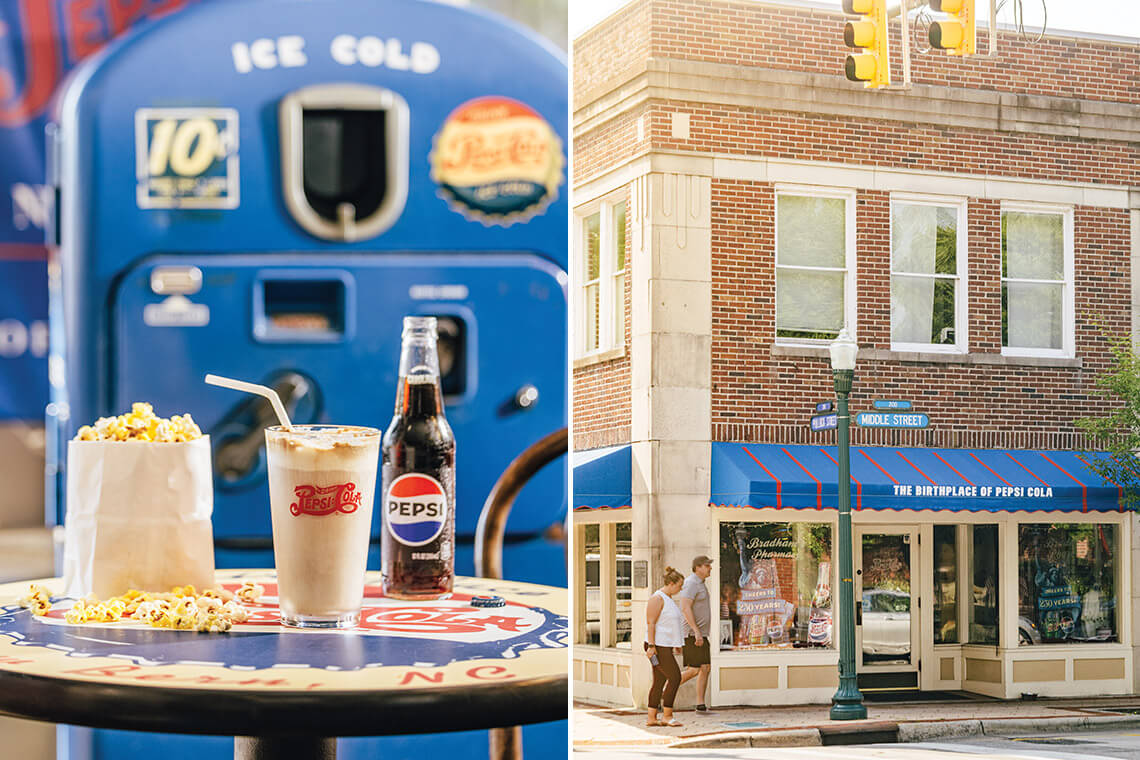
Born in New Bern and Salisbury, Pepsi and Cheerwine remain sweet symbols of North Carolina ingenuity — especially when served ice-cold in the glass bottles that turn every sip into nostalgia. photograph by Baxter Miller
Gripping a glass bottle — better yet, one slick with condensation, water beads rolling down its sides — is one of the great thirst-quenching joys of life. There’s some science behind the feeling: Glass is nonporous and impermeable, helping preserve carbonation and flavor over time. But there’s feeling in it, too — the weight in your hand, the chill against your palm, the sound of the cap letting go.
If you’re lucky, you’ll find them at a place like the Original Mast General Store in Valle Crucis, where the floorboards creak and an old-fashioned cooler hums near the counter. Grab one, pop the top, listen for the hiss, and prepare for one crisp, cold, satisfying swig of nostalgia. — Bryan Mims
The Birthplace of Pepsi
256 Middle Street, New Bern
pepsistore.com
For more about Cheerwine merchandise and its annual festival, visit cheerwine.com.
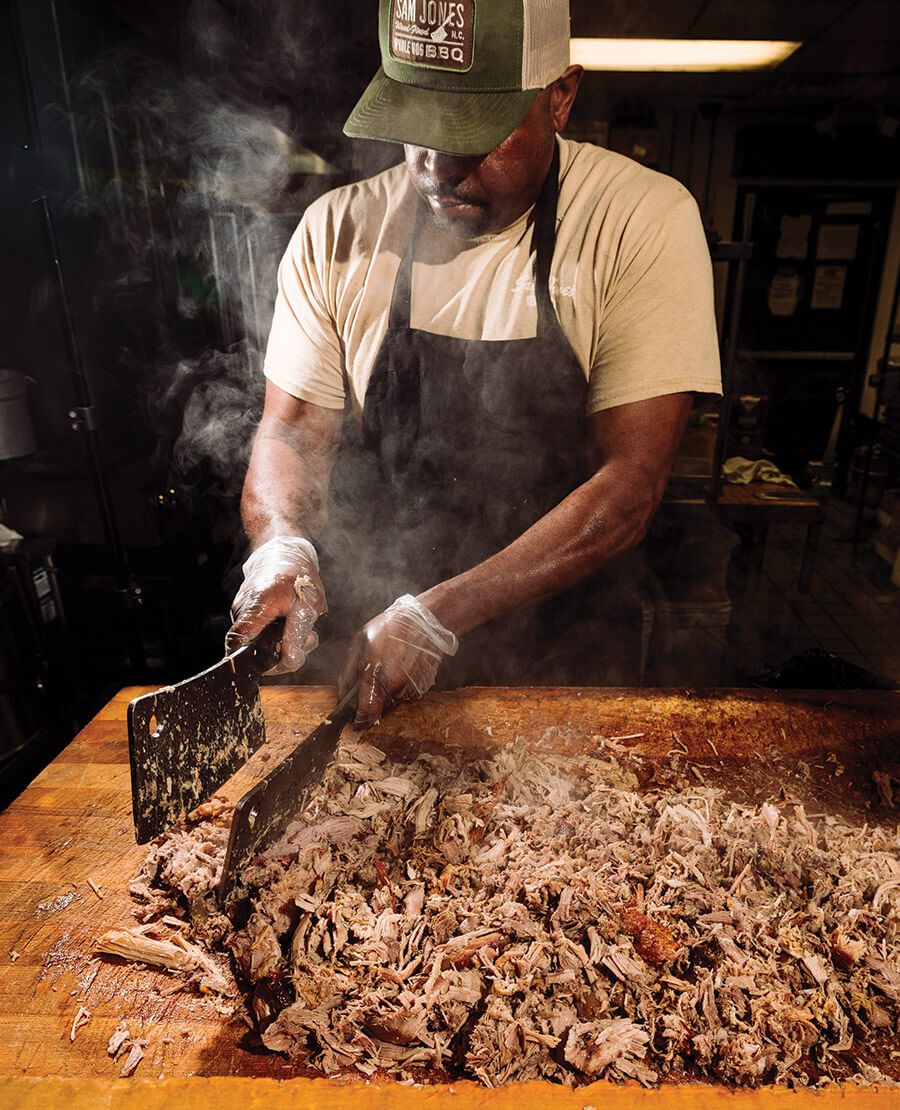
From the block maker’s workshop to the chopping table, thick slabs of hard rock maple stand up to the daily rhythms of eastern North Carolina whole-hog barbecue. photograph by Matt Ray Photography
Barbecue Chopping Block
Made to last
From the Neuse River to the Atlantic coast, eastern North Carolina barbecue requires a steady supply of whole hogs, burning hickory coals, and 10 or 12 hours of time. Then comes the chopping. For that, you need a block that can withstand slow-cooked pork being whacked into bites, bits, and chunks beneath the machine-gun rapping of a cleaver.
Third-generation pitmaster Sam Jones has that figured out, thanks to Ed Swinson of Ed’s Shape Shack.
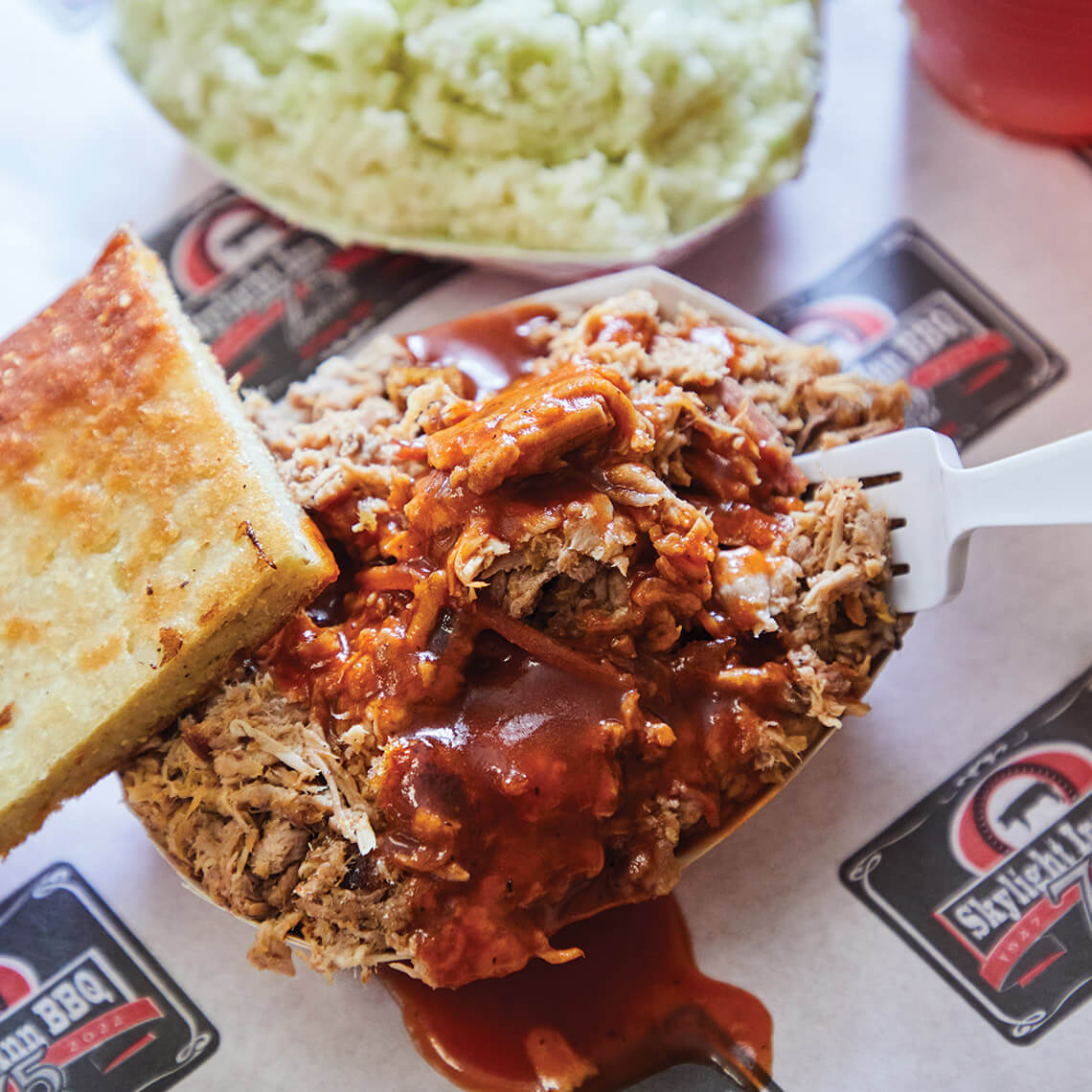
Finely chopped and doused in sauce, Skylight Inn’s barbecue offers a taste of eastern North Carolina. photograph by Chris Rogers
Swinson, a second-generation woodworker, makes blocks for the Jones family’s Skylight Inn in Ayden and the Sam Jones BBQ locations in Winterville and Raleigh. Woodworking is Swinson’s hobby, just as it was for his father, a Vietnam veteran and retired Marine who ran a factory that made tobacco-curing barns.
Jones’s blocks are made from Pennsylvania hard rock maple, reinforced with food-safe adhesive and three threaded rods. They measure 2 feet wide, 4 feet long, and 6 inches thick. With six days a week of chopping and washing, each lasts about a year.
“Somebody who cooks one or two hogs a year, they won’t ever wear it out,” Jones says.
Swinson makes four to six at a time. A similar block would retail for $3,000 to $3,500, but building in batches keeps the cost down.
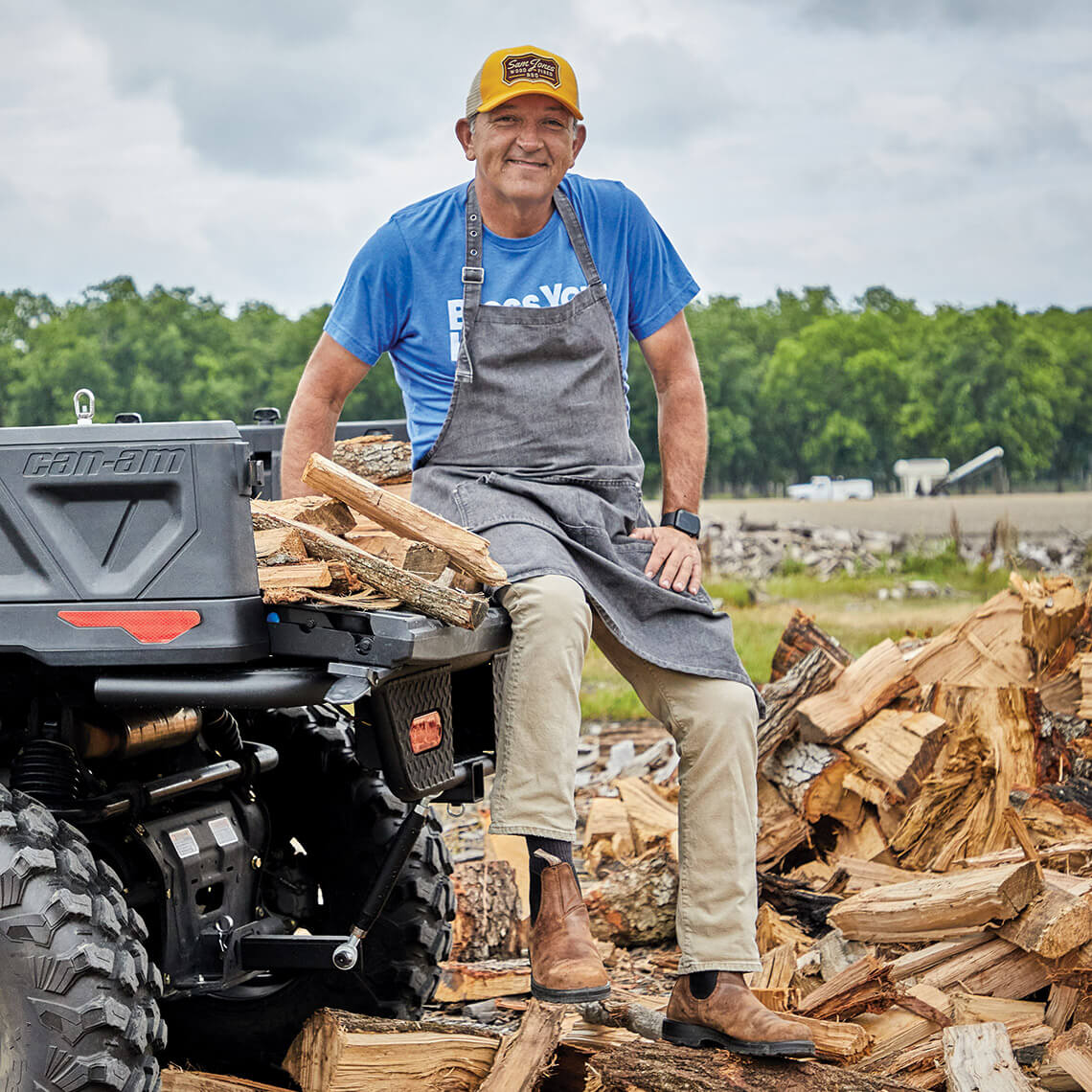
Sam Jones photograph by Chris Rogers
At Jones’s restaurants, one side is used for about six months before the block is flipped. After another six months, Jones sells it, gives it to a supporter, or donates it to a fundraiser. One became a birthday gift for legendary Illinois barbecuer Mike Mills, who died in 2020.
Swinson, who lives in Chicod near Greenville, is a cook himself and takes pride in his contribution to eastern North Carolina barbecue.
“They’re somewhat coveted,” he says. “There are few locations where you can see whole-hog barbecue chopped continuously. I’m not going to lie; it tickles me to hear it.” — Kathleen Purvis
For more information about Ed’s Shape Shack, visit edsshapeshack.com.
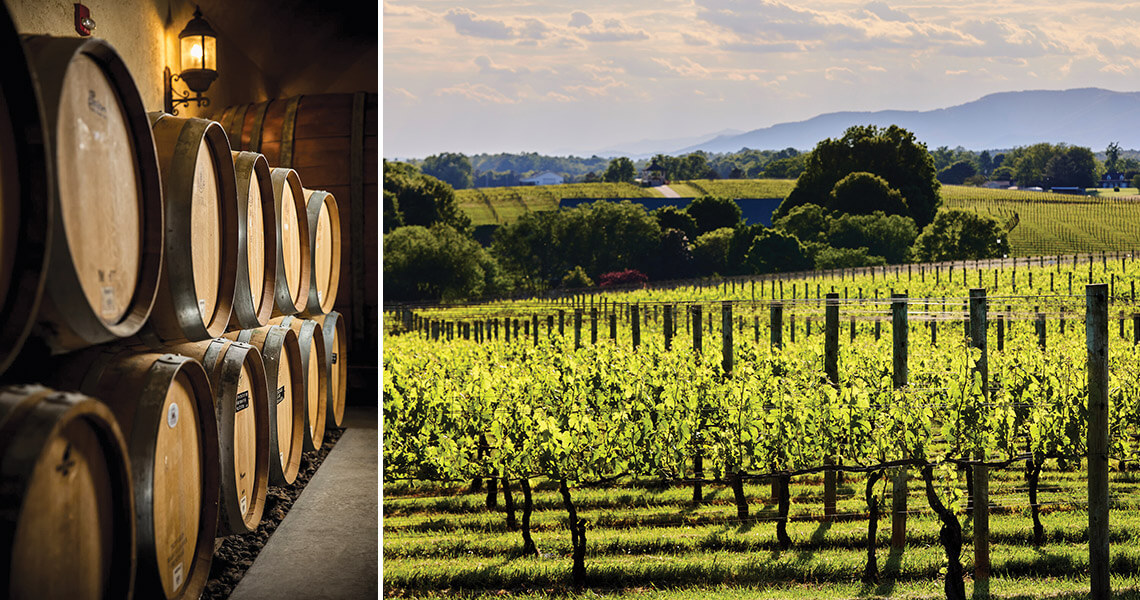
Shelton Vineyards in Dobson is one of 16 stops along the Surry County Wine Trail, which runs through the Yadkin Valley AVA and highlights wineries open for tastings and tours. photograph by Corrie Huggins, Courtesy of Shelton Vineyards; Joey Seawell
Wine Barrel
Grape expectations
Step into the barrel cave at Shelton Vineyards, and you might shiver as the damp chill encircles you. Here, you’re greeted by the aroma of aging wine, earthy and sweet, mingling with the warm, woody fragrance of the oak barrels that slowly add structure, flavor, and character to the wines they hold. Brothers Charlie and Ed Shelton planted their first vinifera vines in Surry County in 1999, then led the charge in the establishment of the first American Viticultural Area in the state, the Yadkin Valley AVA.
But the story of wine in North Carolina begins much earlier, with the Mother Vine, a scuppernong vine on Roanoke Island. Believed to be America’s oldest cultivated grapevine, it might have been planted more than 400 years ago by the Croatan people or early English settlers. Muscadine cultivation flourished, and prior to Prohibition, our state was the leading producer of wine in the country. Today, our state has seven AVAs and produces nearly 50,000 barrels of wine per year. — Rebecca Woltz
photograph by Matt Hulsman
Krispy Kreme Box
The sweetest treasure chest
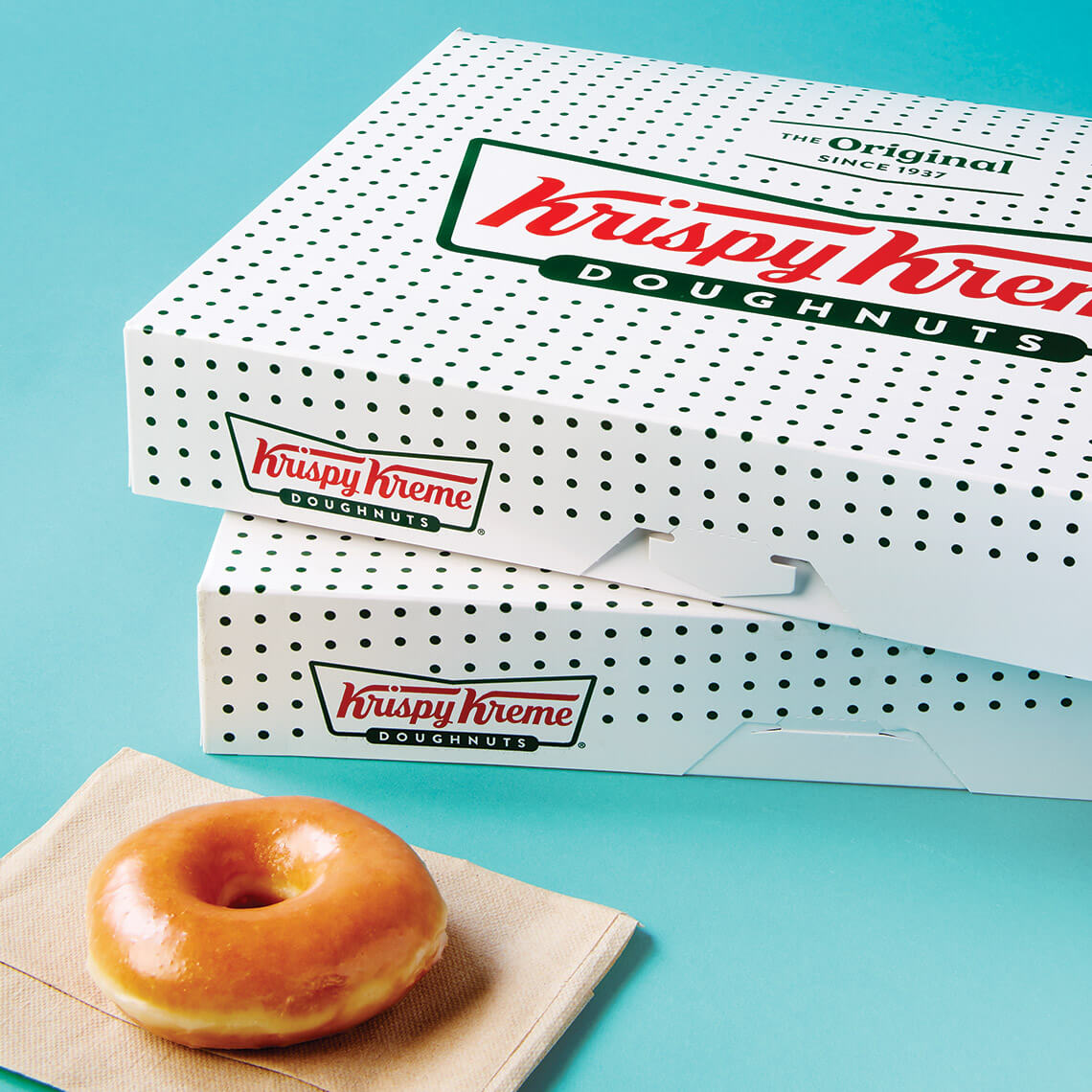
For generations, these classic confections — favored by the dozen — have made their way to offices, schools, church fellowship halls, Little League baseball fields, neighborhood fundraisers, and on. To hold the green-and-white box is to have indulged in a timeless ritual: “HOT NOW” flashes red. Shameless U-turn. Original glazed in hand. Delight. — Alyssa Smith
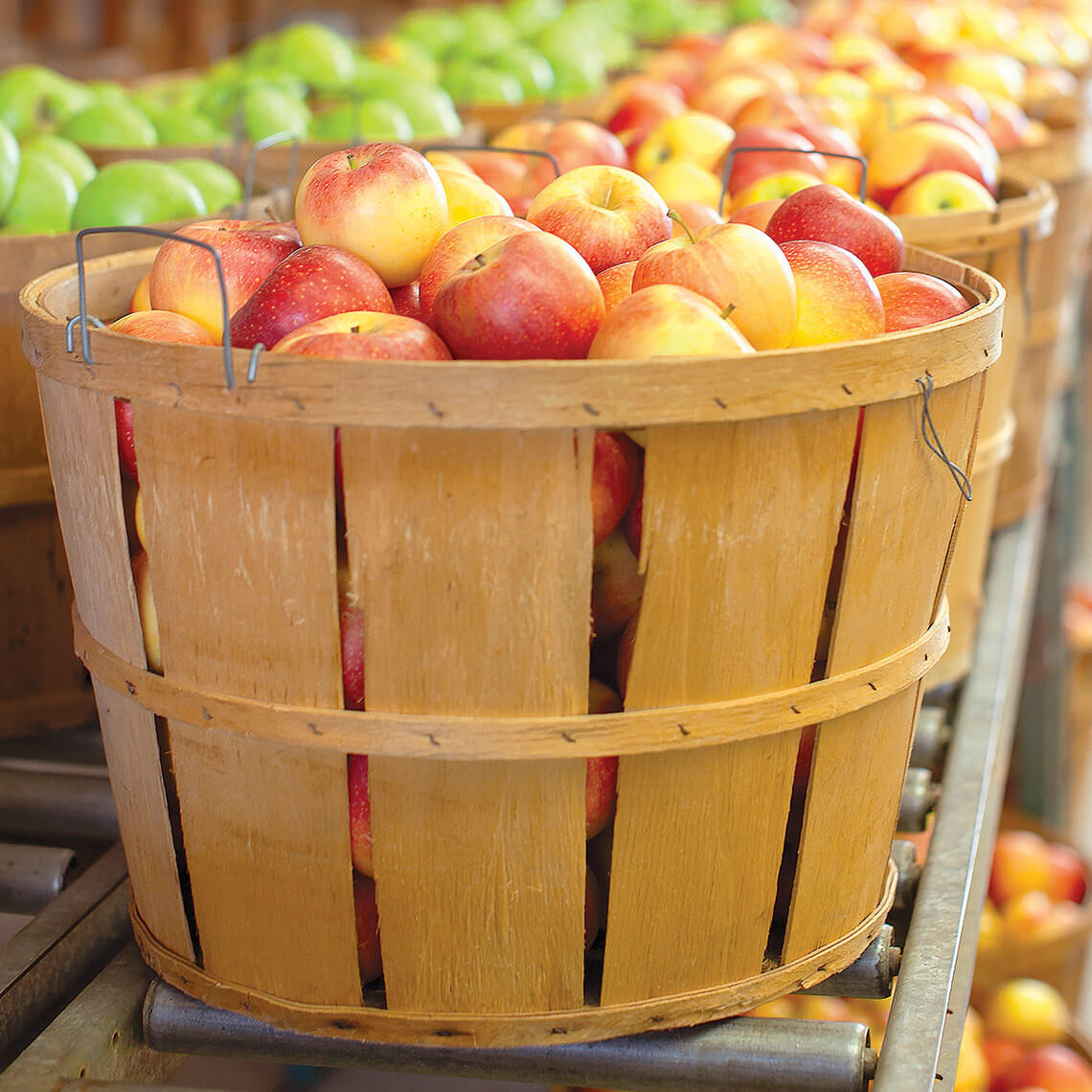
The concentration of orchards and produce stands along U.S. Highway 64 between Hendersonville — home of the North Carolina Apple Festival — and Bat Cave has earned the nickname “Apple Alley.” Here, some spots trace their roots to the pioneer families who first grew apples in the region in 1783. photograph by Stacey Van Berkel
Apple Bushel Basket
The cradle of the crop
From mid-August through October, these baskets are pulled from teetering stacks, a sign of the season as sure as the mountains swapping their green for gold and crimson, woodsmoke drifting through the air, and warm fritters and cider steaming.
Each basket’s impressionable slats bend to hold autumn’s harvest, protecting rosy fruit from bruises while smooth handles polished by generations of hands support the weight. Doubling as a measuring device, these cradles hold a bushel — four pecks, or roughly 40 to 48 pounds — no matter how the apples pile in. A wooden band flexes as the fruit settles — perhaps Rome Beauty, Gala, and Red and Golden Delicious, North Carolina’s leading varieties.
Each year, they’ll hold millions of bushels from hundreds of growers in Henderson, Haywood, Wilkes, and Cleveland counties. Whether stacked in a pickup or resting on a kitchen counter, the humble bushel basket brimming with fresh-picked fruit remains an enduring emblem of a North Carolina autumn. — Alyssa Smith
Pick a peck
The Orchard at Altapass — Collect heirloom varieties and enjoy live bluegrass at this orchard that dates to 1908.
1025 Orchard Road, Spruce Pine
(Milepost 328.3 on the Blue Ridge Parkway)
Southern Heritage Apple Orchard at Horne Creek Farm — Learn about preservation efforts at this 850-tree orchard, home to hundreds of rare and heirloom varieties, some of which are nearly extinct.
308 Horne Creek Farm Road, Pinnacle
Justus Orchard — Choose from popular apple varieties and browse an array of baked goods at this fifth-generation centennial family farm.
187 Garren Road, Hendersonville
Sky Top Orchard — Pick your own, try a warm apple cider doughnut, and take a tractor ride.
1193 Pinnacle Mountain Road, Flat Rock
Apple Hill Orchard and Cider Mill — Fill a wagon and haul your bounty back to this 96-year-old orchard’s Apple House.
2075 Pleasant Hill Avenue, Morganton
— Madalyn Edwards
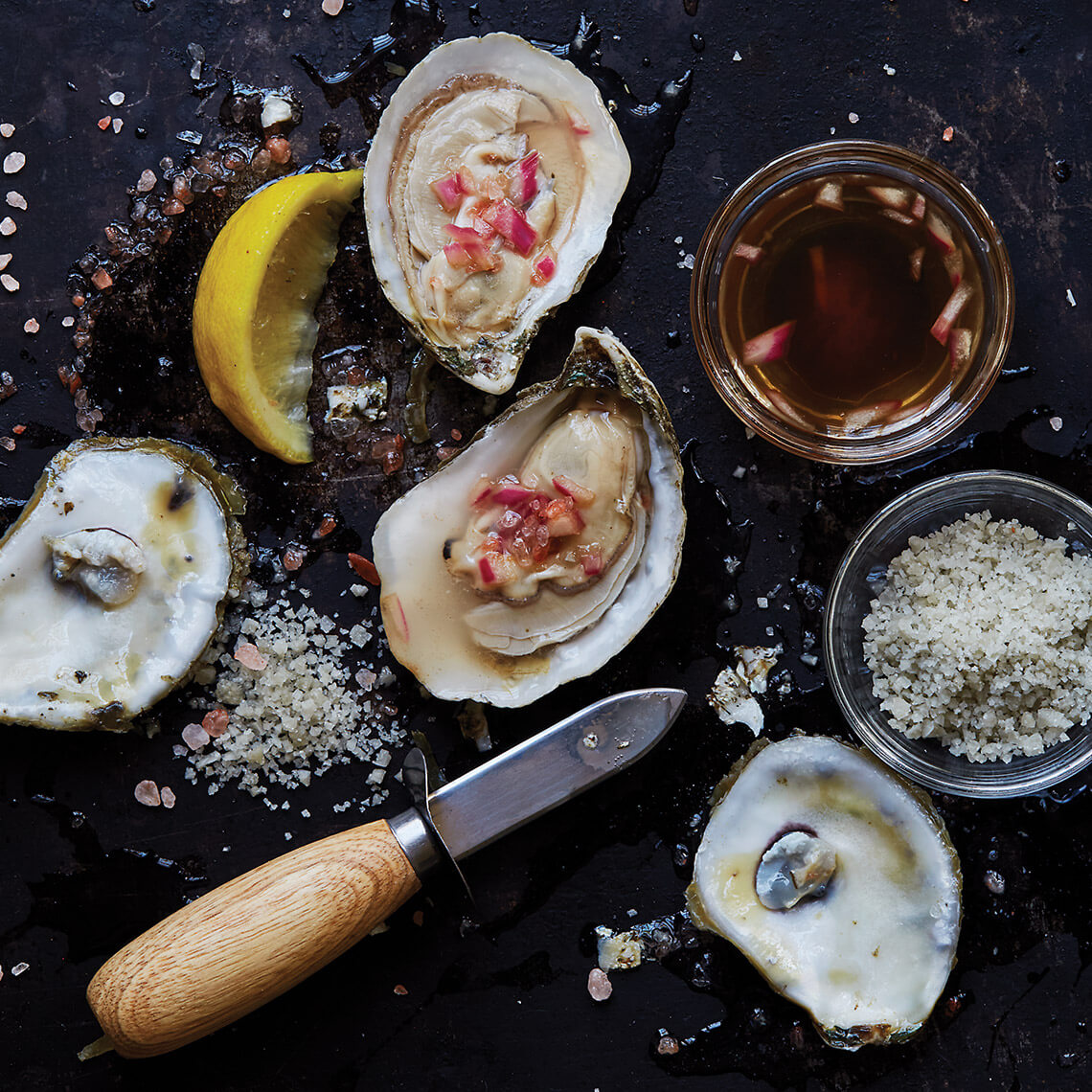
Whether you prefer oysters raw or roasted, dolled up or just as they are, a shucker will help you reveal the briny prize inside the shell. photograph by Stacey Van Berkel
Oyster Shucker
A key to the sea
Oysters are a treat to slurp down for supper, steam with friends on a fall evening, or fawn over in a fried platter, but first you gotta open them up. And for that, you’ll need an oyster shucker.
Yes, you could use an “oyster shucker” to mean “a person who will pry open an oyster for you,” or you could use the oyster shucker tool, a little knife designed to fit in the palm of the hand and set free the delicious flavors locked inside the stony shell.
A proper oyster shucker features a thick, stubby blade with a sharpish point used to penetrate and pry open the “hinge” of the shell. The blade’s blunted edge and rounded tip fit into the tight seam and provide the leverage needed to open an oyster — but with less risk of slicing off a finger or stabbing yourself too badly.
When you have a quality oyster shucker, opening a shell is as easy as 1, 2, 3.
1. Insert oyster shucker at the hinge.
2. Twist.
3. Pop the top.
Getting a clean, consistent shuck on an oyster takes time and repetition, so pick up a bushel and practice until you’re opening yours with nary a speck of shell or sand inside. — Jason Frye